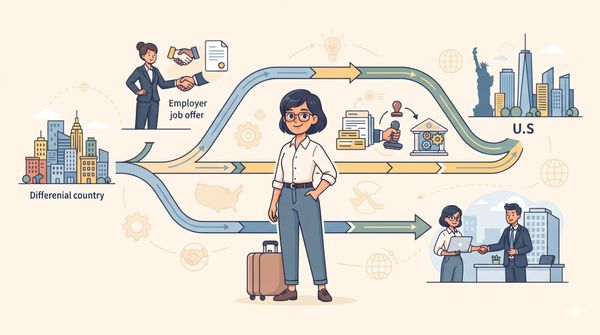
Can Foreigners Work in the US Without a Visa? The Honest Answer
For most foreign nationals, the answer is no. Working in the United States requires permission from the US government. For most people, that permission comes through a work visa or another immigration status that allows employment. Entering as a tourist or through the Visa Waiver Program doesn’t provide it, even for short-term or informal work.
There are real exceptions, though, and they’re more specific than the question suggests. Some people can work in the US without a visa because of their citizenship or immigration status. Others can work for US companies without ever entering the country. Knowing which situation applies makes it much easier to plan a realistic job search.
- A tourist visa, B-1 business visa, or ESTA entry does not allow employment in the United States.
- A visa and work authorisation are different things. Some people can work in the US without a visa, and some visa holders can’t work at all.
- Green card holders, citizens of Micronesia, the Marshall Islands, and Palau, and people with an Employment Authorization Document can work without a work visa.
- Canadian citizens don’t need a visa for TN status, but they still need a qualifying job offer and approval at the border.
- Working remotely for a US company from outside the US generally doesn’t require US immigration permission. Local tax and employment rules still apply.
- LoopCV can help international candidates filter for roles they’re eligible for and answer work-authorisation questions accurately.
What does “working without a visa” actually mean?
The question often mixes up two separate ideas: a visa and work authorisation.
A visa is a travel document that allows someone to ask for entry at a US border. Work authorisation is permission to be employed once inside the country. The two don’t always come together:
- A visa without work rights: A tourist on a B-2 visa has a valid visa but can’t take a job.
- Work rights without a visa: A green card holder doesn’t need a visa to work, and a Canadian professional can receive TN status at the border without a visa stamp.
Location matters too. US immigration rules govern work performed inside the United States. Someone working for a US company from their home country is in a different situation from someone working from a hotel in New York.
Who can work in the US without a visa?
A few groups can legally work in the US without holding a work visa. Each comes with its own conditions.
Green card holders
Lawful permanent residents can work for almost any employer in the US without a visa or a separate work permit. A green card is an immigration status, not a temporary visa. Getting one usually takes years through family, employment, or other immigration routes.
Citizens of Micronesia, the Marshall Islands, and Palau
Under the Compacts of Free Association, citizens of these three countries can live and work in the US indefinitely without a visa. USCIS lists them among the groups authorised to work without restriction. They still need acceptable documents when an employer verifies their eligibility.
Canadian professionals with TN status
Canadian citizens don’t need a visa to work in the US as USMCA professionals. According to the State Department, they can request TN status directly at a US port of entry.
That doesn’t mean Canadians can simply cross the border and start working. They still need:
- A job offer from a US employer.
- A profession on the USMCA list, such as engineer, accountant, or scientist.
- The qualifications the profession requires, usually a bachelor’s degree.
Mexican citizens can also qualify for TN status, but they must apply for a TN visa first.
People with an Employment Authorization Document
Some people in the US receive work permission through a pending or approved immigration process rather than a work visa. This can include refugees, asylees, certain asylum applicants, Temporary Protected Status holders, and applicants for a green card. Many of them prove their eligibility with an Employment Authorization Document (EAD).
The process that makes someone eligible for an EAD is separate from job hunting. An EAD can’t be obtained just to take a job offer.
Can you work in the US on a tourist visa or ESTA?
No. The State Department states that someone on a visitor visa is not permitted to accept employment or work in the United States. The same restriction applies to travellers entering under the Visa Waiver Program with ESTA.
Business visitors can take part in limited activities, such as:
- Attending meetings and consulting with business associates.
- Attending conferences or trade shows.
- Negotiating contracts.
- Taking part in short-term training that doesn’t involve productive work.
Interviewing for a job is generally allowed as well. Starting the job after the interview isn’t.
Remote work while visiting is a grey area that many people underestimate. Visitor rules make no exception for working on a laptop for a company back home. Immigration attorneys generally advise against ongoing remote work during a visit. Telling a border officer “I’ll be working remotely” can lead to questions or a refused entry.
Pro Tip: Offers that promise US jobs “without a visa,” or that ask for upfront visa processing fees, are a common scam pattern. Run any suspicious posting through LoopCV’s Job Scam Detector before sharing personal documents or paying anything.
Can you work for a US company from outside the US?
Generally, yes. If the work happens entirely outside the United States, US immigration permission usually isn’t required. Many US companies hire international talent as contractors or through employer-of-record services.
This option has its own conditions:
- Local rules apply: The candidate must follow the tax, contractor, and employment rules of the country they work from.
- Hiring is the employer’s choice: Some US companies only hire people who live in specific countries, mainly for legal or payroll reasons.
- It doesn’t allow relocation: A remote role with a US company doesn’t give anyone the right to move to the US and keep working.
Before accepting an overseas remote role, check the time zones, contract type, payment method, and benefits. The things to consider before applying for a remote role overseas cover these questions in more detail.
Pro Tip: LoopCV’s Job Filtering can narrow a search by location and work arrangement, which helps avoid listings that require US-based candidates. Still read each job description, because some “remote” roles are remote only within the US.
What happens if someone works in the US without authorisation?
Unauthorised work is a serious immigration violation, and the consequences can last well beyond the job itself. Depending on the case, they can include:
- Losing current immigration status.
- Visa cancellation or removal from the US.
- Problems with future green card applications, since unauthorised employment can block some applicants from adjusting status.
- Refused visas or entry on future trips.
Legitimate employers also can’t legally hire someone without checking. US employers must complete Form I-9 for every new hire, verifying both identity and employment authorisation. A job that skips this step isn’t a workaround. It exposes the worker to legal risk and often to exploitation.
The same honesty applies to application forms. Questions such as “Are you legally authorised to work in the US?” and “Will you require sponsorship?” are screening questions that can decide whether an application moves forward. They belong among the parts of a job application that need human review, even when the rest of the process is automated.
Pro Tip: LoopCV’s AI Question Answering can fill in routine application questions faster. Check every answer about work authorisation and sponsorship before submitting, because an incorrect answer can cause problems later in the hiring process.
What are the legal routes if no exception applies?
Most people who want to work in the US need an employer to sponsor them or a visa category based on their background. Common options include:
- H-1B: For specialty occupations, usually requiring a degree. Selection uses a lottery that has been weighted by wage level since the 2026 registration. A $100,000 fee on certain new petitions, introduced in September 2025, has been challenged in court, so check its current status with USCIS before relying on it.
- L-1: For employees transferring to a US office of the same company, usually after a year with the company abroad.
- O-1: For people with extraordinary ability or achievement in their field.
- E-3 and H-1B1: For citizens of Australia (E-3) and of Chile or Singapore (H-1B1) in specialty occupations.
- Employment-based green cards: Such as the EB-3 visa for skilled and other workers, which leads to permanent residence.
Each route depends on an employer, qualifications, or both. That makes targeting the right employers essential. Knowing how to find jobs with visa sponsorship saves time compared with applying broadly and hoping sponsorship comes up later.
Immigration rules change often, and individual circumstances vary. Check the official USCIS and State Department guidance, and speak with a qualified immigration attorney before making decisions.
How LoopCV can help you target jobs you’re eligible for
For international candidates, the hard part of a US job search is often finding roles they can legally accept, not finding roles at all. LoopCV helps narrow the search and manage applications more carefully.
- Find relevant roles: The AI Job Search Tool surfaces opportunities based on target roles, locations, and preferences.
- Filter out unsuitable listings: Job Filtering and Exclude Companies help remove roles and employers that don’t fit the candidate’s situation.
- Match against the profile: Job Matching ranks opportunities by how closely they align with the candidate’s background.
- Check the resume: The AI CV Checker reviews structure, content, and ATS readiness before applications go out.
- Tailor the resume: The AI CV Builder helps adapt a resume for US employers and specific roles.
- Choose how to apply: Auto Apply handles repetitive submissions, while One-Click Apply lets candidates review each match first.
- Track every application: The Job Application Tracker keeps applications, responses, and follow-ups in one place.
These tools can reduce manual work, but they can’t change a candidate’s eligibility. Work authorisation should be confirmed before applying, not discovered after an offer.
Conclusion
Most foreigners can’t work in the US without a visa or another form of work authorisation, and visiting as a tourist doesn’t change that. The exceptions are real but specific: green card holders, citizens of the Compact countries, Canadian TN professionals, and people with an EAD through another immigration process.
For everyone else, there are two realistic paths. One is remote work for US companies from outside the country. The other is a targeted search for employers who can sponsor a work visa. Either path starts with being clear about eligibility and honest about it in every application.
FAQs
Can I work in the US on a tourist visa?
No. B-1 and B-2 visitor visas, and ESTA entries under the Visa Waiver Program, don’t permit employment in the United States. Business visitors can attend meetings, conferences, and contract negotiations, but they can’t take a job.
Do Canadians need a visa to work in the US?
Canadians don’t need a visa for TN status, but they do need work authorisation. They can request TN status at a US port of entry with a qualifying job offer in a profession on the USMCA list.
Can I work remotely for a US company while living abroad?
Generally, yes. If the work is performed entirely outside the US, US immigration permission usually isn’t required. The candidate still needs to follow the tax and employment rules of the country they work from.
Can I work remotely for my home-country employer while visiting the US?
Visitor rules contain no clear exception for remote work. Immigration attorneys generally advise against ongoing remote work during a visit, because it can be treated as unauthorised employment. An attorney can advise on specific circumstances.
What happens if I work in the US illegally?
Unauthorised work can lead to loss of status, removal, and refused visas or entry in the future. It can also affect future green card applications. The risk usually outweighs any short-term benefit.