
How to Find Jobs That Actually Sponsor Work Visas in 2026
Finding a job overseas is only half the challenge. The bigger question is whether the employer can and will sponsor the work visa needed to take the job.
A role can match the skills perfectly and still be a dead end if the employer only considers candidates who already have work authorization. That makes sponsorship one of the first things international candidates should check, rather than something to investigate after several rounds of interviews.
The process also varies by country. In the UK, for example, an employer generally needs an approved sponsor licence and the role must meet the requirements of the relevant visa route. In the US, public Department of Labor data can provide useful evidence of an employer's previous Labor Condition Application filings.
The goal is simple: find employers with a real sponsorship pathway, verify that the specific role can support it, and only then invest time in the application.
- Check job descriptions for explicit visa sponsorship language and clarify any unclear requirements with the recruiter.
- Verify whether the employer is authorised to sponsor workers and whether the specific role qualifies for the required visa route.
- Previous sponsorship activity, active sponsor licences, and dedicated relocation support can help identify employers worth prioritising, but do not guarantee sponsorship.
- Use visa-specific keywords and search across multiple job boards, company career pages, recruitment platforms, and public employment resources to find relevant opportunities.
- Tailor the CV to highlight relevant skills, qualifications, experience, and measurable achievements without adding unsupported keywords.
- Confirm sponsorship eligibility early and check the role's salary, location, relocation support, and career progression before investing heavily in the application.
- LoopCV can help discover relevant jobs, tailor CVs, automate applications, filter opportunities, and track applications, while candidates verify sponsorship for each role.
Start With the Sponsorship Language in the Job Posting
The easiest place to check for sponsorship is the job description itself.
Look for phrases such as:
- "Visa sponsorship available"
- "Will sponsor qualified candidates"
- "Open to candidates requiring sponsorship"
- "Work visa sponsorship provided"
- "Skilled Worker sponsorship"
- "H-1B sponsorship"
- "Relocation and visa support available"
These phrases indicate that sponsorship may be part of the hiring process.
Also watch for language that rules sponsorship out. Common examples include:
- "Must have the right to work"
- "No visa sponsorship available"
- "Candidates must already be authorized to work"
- "No relocation or sponsorship provided"
A statement such as "international candidates welcome" is not enough on its own. It does not necessarily mean the company will sponsor a work visa.
Candidates can also search visa sponsorship jobs, where roles are filtered by whether the employer sponsors rather than by location alone
Check Whether the Employer Is Actually Set Up to Sponsor
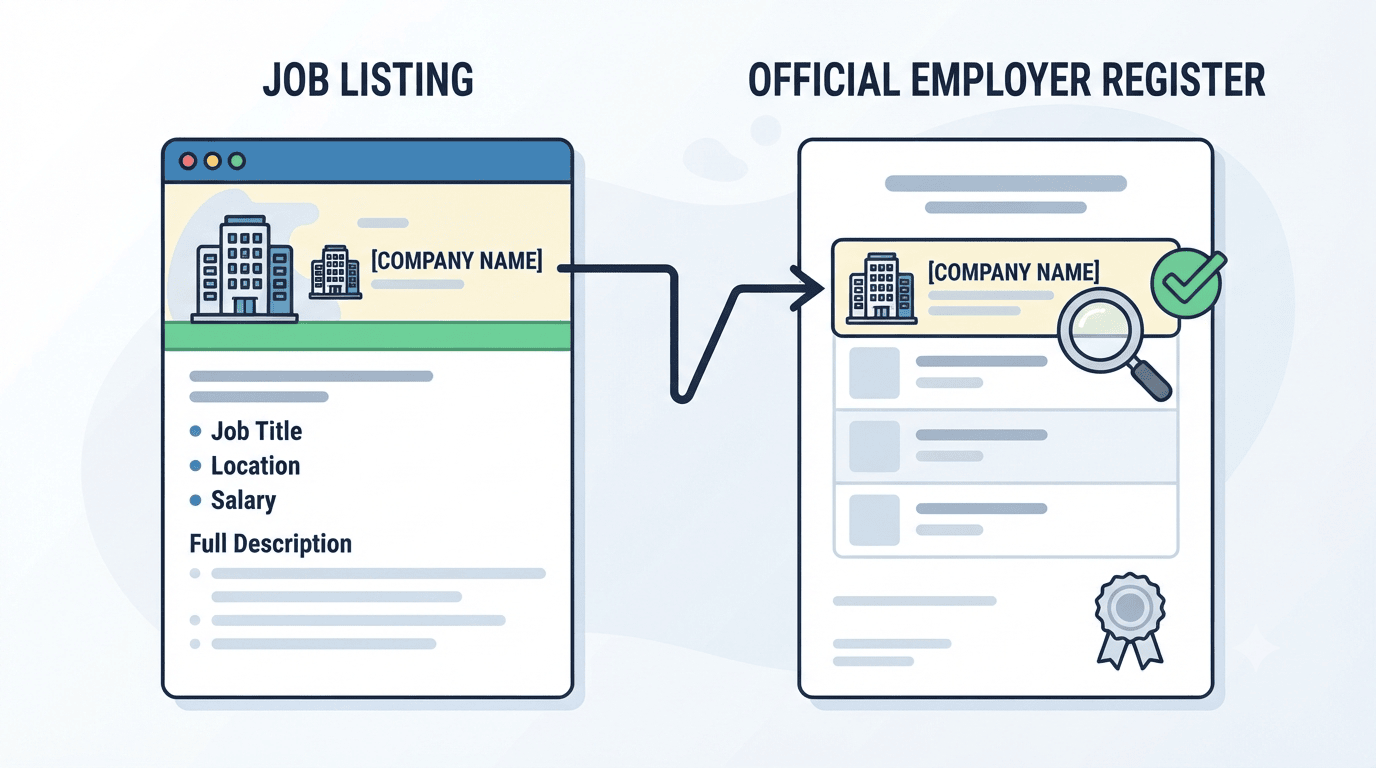
A company mentioning international hiring does not automatically mean it can sponsor every candidate.
For the UK, the Register of licensed sponsors: workers provides a list of organisations licensed to sponsor workers. The UK also sets specific requirements around the job, employer, salary and Certificate of Sponsorship for the Skilled Worker route. The official Skilled Worker guidance can help candidates check whether a role fits those requirements.
For the US, the Department of Labor's Foreign Labor Certification performance data includes public disclosure data for Labor Condition Applications and other employment-based programs.
The important question is not simply:
"Can this company sponsor?"
It is:
"Has this employer sponsored workers before, and does this particular role appear suitable for sponsorship?"
That distinction can save a lot of wasted applications.
Look for a Sponsorship Track Record
Previous sponsorship activity can be a useful signal when evaluating employers.
Look for signs such as:
- An active sponsor licence where applicable
- Previous work visa or LCA filings
- Job postings that explicitly mention sponsorship
- Dedicated international relocation support
- A history of hiring candidates from different countries
- Recruiters or hiring teams familiar with immigration processes
Past sponsorship does not guarantee that a company will sponsor a particular role. Sponsorship policies can vary by department, position, location and hiring budget.
Still, an employer with an established international hiring process may be worth prioritising over one with no visible sponsorship history.
Search Using Visa-Specific Keywords
Generic searches such as "software engineer jobs in UK" or "marketing jobs in USA" can return thousands of roles without making sponsorship requirements clear.
Adding sponsorship-related keywords can make the search more focused.
Try combinations such as:
- "visa sponsorship software engineer"
- "jobs with visa sponsorship"
- "UK Skilled Worker sponsorship jobs"
- "H-1B sponsorship jobs"
- "visa sponsorship marketing jobs"
- "relocation and visa sponsorship"
- "international candidates sponsorship"
- "employer sponsored jobs"
The right keyword depends on the destination country and visa route. In the UK, the Skilled Worker visa requirements can help clarify what type of employment qualifies.
Searching this way also makes it easier to spot employers that openly communicate their sponsorship policies.
Tailor Your CV for the Sponsored Role
International applications can involve more screening because recruiters need to assess both professional fit and work eligibility.
The CV should therefore make the relevant qualifications easy to identify.
Match the CV to the role by highlighting:
- The exact or closely related job title
- Relevant technical and professional skills
- Required certifications
- Years of relevant experience
- Industry-specific knowledge
- Measurable achievements
- Tools and technologies mentioned in the job description
Avoid adding keywords that do not accurately describe the candidate's experience. The goal is to make genuine qualifications easier to find during screening.
Pro tip: Use LoopCV's Resume Keywords Checker to compare your CV against a specific job description and identify relevant keyword gaps before applying.
Search Across Multiple Job Sources
Sponsorship opportunities are spread across different job boards, company career pages and specialist recruitment platforms. Relying on one source can limit the number of suitable opportunities available.
A broader search can include:
- Major job boards
- Employer career pages
- Specialist recruitment sites
- Government or public employment resources
- Visa-specific job searches
- International recruitment agencies
The key is to keep the search focused. More job listings do not automatically mean better opportunities.
Pro tip: Use LoopCV's AI Job Search Tool to discover relevant roles based on job preferences, locations, and search criteria instead of manually checking multiple sources one by one.
Ask About Sponsorship Before the Process Goes Too Far
If the job description does not clearly state the sponsorship policy, asking early can prevent wasted time.
A simple question to a recruiter could be:
"Could you confirm whether this position is open to candidates who require work visa sponsorship?"
This is especially useful before spending significant time on assessments, interviews or lengthy application processes.
The answer can also reveal an important distinction. A company may sponsor visas in general but only for specific positions or seniority levels.
Visa sponsorship also does not guarantee visa approval. For example, UK applicants still need to meet the relevant visa requirements even when the employer is an approved sponsor.
How LoopCV can help with international job search
LoopCV can help manage several parts of an international job search from one place. Candidates can use it to find relevant roles, tailor applications, automate repetitive tasks and keep track of applications while still checking sponsorship eligibility for each position.
- AI Job Search: Find relevant opportunities based on job title, location, seniority, keywords and other preferences with the AI Job Search Tool.
- CV building: Create and customise resumes for different roles with the AI CV Builder.
- Keyword optimisation: Compare a CV with a job description and identify relevant keyword gaps using the Resume Keywords Checker.
- Automated applications: Reduce repetitive application work with Auto Apply.
- Job filtering: Narrow down opportunities according to specific search preferences with Job Filtering.
- Application tracking: Keep applications organised and monitor their progress with the Job Application Tracker.
- Job matching: Find roles that better align with a candidate's profile using Job Matching.
The important part is to use these features alongside sponsorship checks. LoopCV can help find and manage opportunities, but candidates should still verify whether the specific employer and role can sponsor the required visa.
Pro tip: Before applying for a sponsored role, use LoopCV's Resume Keywords Checker to check whether your CV reflects the skills and terminology used in the job description.
Don't treat sponsorship as the only filter

Finding an employer willing to sponsor a visa is important, but it should not be the only factor used to evaluate a job.
Before applying, check:
- Whether the role matches the candidate's experience
- Whether the employer can sponsor the relevant visa route
- Whether the specific position is eligible
- Whether the salary meets the applicable requirements
- Whether the location works
- Whether relocation support is available
- Whether the role offers reasonable career progression
A job that sponsors visas but has a poor professional fit may not be worth pursuing.
The strongest opportunities are those where the role, employer, sponsorship pathway, salary and candidate's qualifications all line up.
Conclusion
Finding a job with visa sponsorship requires more than searching for jobs in another country.
The strongest approach is to identify sponsorship language, verify the employer's status or previous sponsorship activity, check whether the specific role qualifies, and confirm the policy with the recruiter when necessary.
A targeted CV and a broader job search can then increase the number of relevant opportunities without wasting time on roles that were never open to sponsorship.
LoopCV can help automate and organise much of the job search, but sponsorship remains something candidates should verify for each role before investing heavily in the application process.
FAQs
How can I tell if a job offers visa sponsorship?
Check the job description for terms such as "visa sponsorship," "work visa sponsorship," "Skilled Worker sponsorship" or "H-1B sponsorship." If the listing is unclear, ask the recruiter directly.
Can any company sponsor a work visa?
Not necessarily. Sponsorship rules depend on the country, employer and visa route. Some employers need an approved sponsor licence or must meet other requirements before sponsoring workers.
Does a company that sponsored employees before still sponsor today?
Not automatically. Previous sponsorship activity is a useful signal, but sponsorship policies can change and may differ between roles. Always verify the current policy for the specific position.
Should sponsorship be mentioned on a CV?
The CV should focus primarily on qualifications, experience and achievements. If work authorization or sponsorship status is relevant to the application, it can be addressed clearly where appropriate rather than taking up significant space on the CV.
Can LoopCV find jobs with visa sponsorship?
LoopCV can help discover and manage relevant job opportunities based on search criteria. Candidates should still check the individual job posting and employer information to confirm whether sponsorship is available for that specific role.