
What Is in a Cover Letter?
A cover letter is one of the most important parts of a job application, yet many candidates are unsure what to include or how to structure it. Some repeat their CV, others write something too long, and many struggle to tailor it for each role.
So, what is in a cover letter?
A strong cover letter is a short, structured document that explains who you are, why you are applying, and why you are a good fit for the role. It complements your CV by adding context, clarity, and intent.
Instead of listing everything you have done, a cover letter focuses on what matters most for a specific role and helps the employer understand how your experience connects directly to their needs.
Why Cover Letters Still Matter
Even though some companies mark cover letters as optional, they are still a valuable part of the application process.
A well-written cover letter allows you to:
- Explain why you are interested in the role
- Highlight your most relevant experience
- Show how your skills align with the company’s needs
- Demonstrate communication and clarity
- Provide context that may not be obvious from your CV
In competitive roles, this additional context can help you stand out from other candidates with similar backgrounds. It also shows effort and attention to detail, which are often evaluated during the hiring process.
The Essential Parts of a Cover Letter
A strong cover letter is usually structured into a few key sections. Each part has a specific purpose.
1. Introduction
The opening should clearly state:
- The role you are applying for
- Where you found the job
- A brief introduction of your background
This section should be direct and concise. The goal is to quickly give the reader context and make it clear why you are reaching out.
2. Why You Are a Good Fit
This is the core of your cover letter.
Here, you should:
- Highlight relevant experience
- Connect your skills to the role
- Show measurable results
Instead of describing responsibilities, focus on outcomes.
For example:
- Increased customer engagement by 40%
- Reduced operational costs by 20%
- Led projects that improved team efficiency
This helps employers understand the value you can bring and how your past work translates into results for their organization.
3. Why This Company
A strong cover letter should also explain why you are applying to this specific company.
This shows that you have:
- Researched the company
- Understood its product or mission
- A genuine interest in the role
Avoid generic statements. Be specific about what attracts you to the company, whether it is their product, culture, or market position.
4. Closing Paragraph
The final section should:
- Reaffirm your interest
- Express willingness to continue the conversation
- Thank the reader
Keep it short, professional, and confident without sounding overly formal or repetitive.
How Long Should Cover Letters Be?
A common question is: how long should cover letters be?
A cover letter should typically be:
- Around 250–400 words
- No more than one page
- Structured in 3–5 short paragraphs
Hiring managers often review many applications, so clarity and brevity are important. A longer cover letter does not add value if it repeats your CV. A shorter, focused letter that highlights key points is more effective.
Do You Always Need a Cover Letter?
Not every job requires a cover letter, but including one can still be beneficial.
You should consider writing a cover letter when:
- The application specifically requests one
- The role is competitive
- You are changing careers or industries
- You want to explain something not obvious from your CV
Even when optional, a strong cover letter can provide additional context and improve your chances of getting noticed.
What to Avoid in a Cover Letter
Many candidates make common mistakes that reduce the effectiveness of their cover letter.
Avoid:
- Repeating your CV word-for-word
- Writing long, unfocused paragraphs
- Using generic templates without customization
- Focusing on responsibilities instead of results
- Sending the same letter to every company
A good cover letter should feel tailored and relevant to the role, even if you are using a consistent structure.
How to Create a Cover Letter Faster
Writing a cover letter is not difficult, but doing it repeatedly for multiple applications can become time-consuming.
If you are applying to several roles, you may need to:
- Adjust your content for each job
- Match your skills to different requirements
- Maintain a consistent structure
- Keep your writing clear and concise
Instead of starting from a blank page every time, using a structured approach can help you save time and stay consistent across applications.
Use a Cover Letter Generator to Save Time
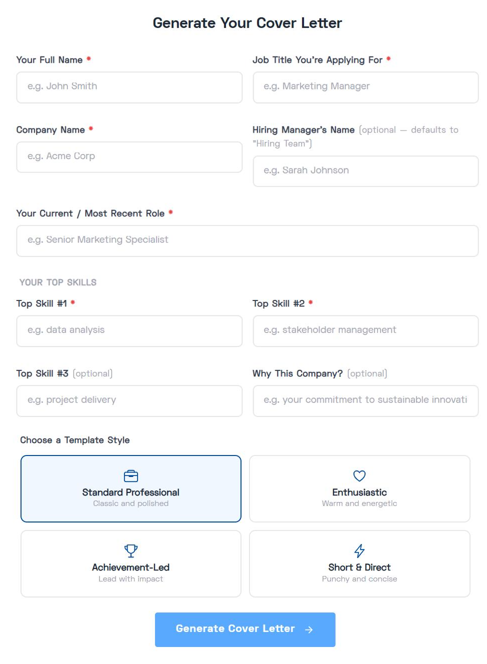
One practical way to speed up the process is to use a tool that helps you generate a tailored cover letter based on your input.
LoopCV provides a cover letter generator that allows you to create a professional draft in seconds.
You simply:
- Enter your details (job title, company, skills)
- Choose a tone (standard, enthusiastic, achievement-led, or short and direct)
- Copy your generated cover letter and use it in your application
This approach is especially useful if you are applying to multiple roles and need to adapt your content quickly without losing quality.
You can use the tool here:
https://www.loopcv.pro/tools/cover-letter-generator
Beyond the Cover Letter: Managing Your Applications
Once your cover letter is ready, the next challenge is managing your job search.
Applying to multiple roles involves:
- Finding relevant job opportunities
- Customizing your CV and cover letter
- Submitting applications
- Tracking progress
Doing all of this manually can take time and make it difficult to stay consistent.
LoopCV helps simplify this process by allowing you to:
- Discover relevant job opportunities automatically
- Apply to roles more efficiently
- Track all your applications in one place
This allows you to focus on improving your applications while reducing the time spent on repetitive tasks.
Final Thoughts
So, what is in a cover letter?
A strong cover letter includes:
- A clear introduction
- Relevant experience and measurable results
- A reason for applying to the company
- A concise and professional closing
It should be structured, tailored, and focused on value.
While your CV shows your experience, your cover letter explains why you are the right fit. When done correctly, it can strengthen your application and improve your chances of moving forward.
If you want to create cover letters more efficiently and manage your job search in a more structured way, you can get started here:
👉 https://www.loopcv.pro/signup