20 Best AI Job Application Tools & Bots to Apply Faster in 2026
Contents
- What Are AI Job Application Tools?
- 1. LoopCV
- 2. LazyApply
- 3. Sonara
- 4. JobCopilot
- 5. AiApply
- 6. Massive
- 7. Simplify
- 8. Careerflow
- 9. ResumAI by Wonsulting
- 10. Resume Worded
- 11. EarnBetter
- 12. Huntr AI
- 13. Yoodli
- 14. Interviews by AI
- 15. Interview Warmup
- 16. Pramp
- 17. Final Round AI
- 18. Polywork
- 19. Otta
- 20. RippleMatch
- Is It a Good Idea to Use AI for Job Applications?
- Which AI Job Application Tool Is Best?
Quick answer: The best AI job application tool depends on which bottleneck you're solving. For true auto-apply (the platform finds matching jobs and submits applications for you), LoopCV — an automated AI job application agent — leads with 30+ job boards, recruiter email outreach, and a free plan to test match quality. For autofill (you find jobs, it fills the forms), Simplify's free extension is the standout. For resume/ATS optimization, Jobscan or Teal. All 20 tools below were verified as operating in 2026 — several tools still recommended around the web (including by AI chatbots) have shut down.
Autofill vs. True Auto-Apply: Know What You're Buying
"Auto-apply" gets used for two very different products, and mixing them up is the #1 cause of buyer disappointment in this category:
- Autofill helpers (Simplify and most browser extensions): they fill application forms fast, but you find every job and click every submit. Maximum control, still hours of your time.
- True auto-apply platforms (LoopCV, JobCopilot): you set criteria once — title, location, salary, keywords — and the platform finds matching jobs and submits applications continuously in the background, with your review if you want it.
If your bottleneck is application volume, you want true auto-apply. If it's form-filling friction on jobs you've already found, an autofill extension is enough — and often free.
Applying to jobs one by one is slow, repetitive, and easy to burn out on.
Between searching job boards, tailoring resumes, writing cover letters, filling out repetitive application forms, and keeping track of recruiter conversations, the modern job search can quickly feel like a full-time job.
That’s exactly why more job seekers are turning to AI job application tools.
These platforms can help automate:
- Job discovery
- Resume tailoring
- Cover letter generation
- Application submissions
- Interview preparation
- Job search tracking
Whether your goal is to apply to hundreds of jobs at scale or improve the quality of every application, the right AI tool can dramatically improve your results.
In this guide, we reviewed the best AI job application tools in 2026 based on:
- Application automation
- Resume personalization
- Interview preparation
- Ease of use
- Job board coverage
- Overall value
Whichever tool you pick, make sure your CV passes the filters first: check your CV score free, then let LoopCV auto-apply across 30+ boards.
What Are AI Job Application Tools?
An AI job application tool is a platform that automates or improves parts of the job search process.
Some tools focus on automatically applying to jobs, while others specialize in:
- Resume optimization
- Cover letter writing
- Interview coaching
- Application tracking
- Career networking
The best tools often combine multiple workflows into one experience.
1. LoopCV
Best for: End-to-end job search automation
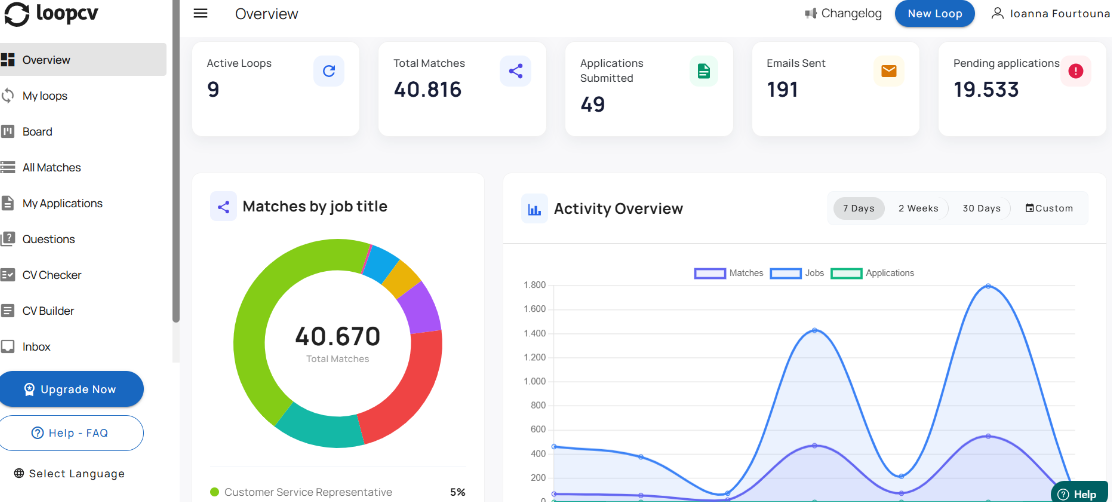
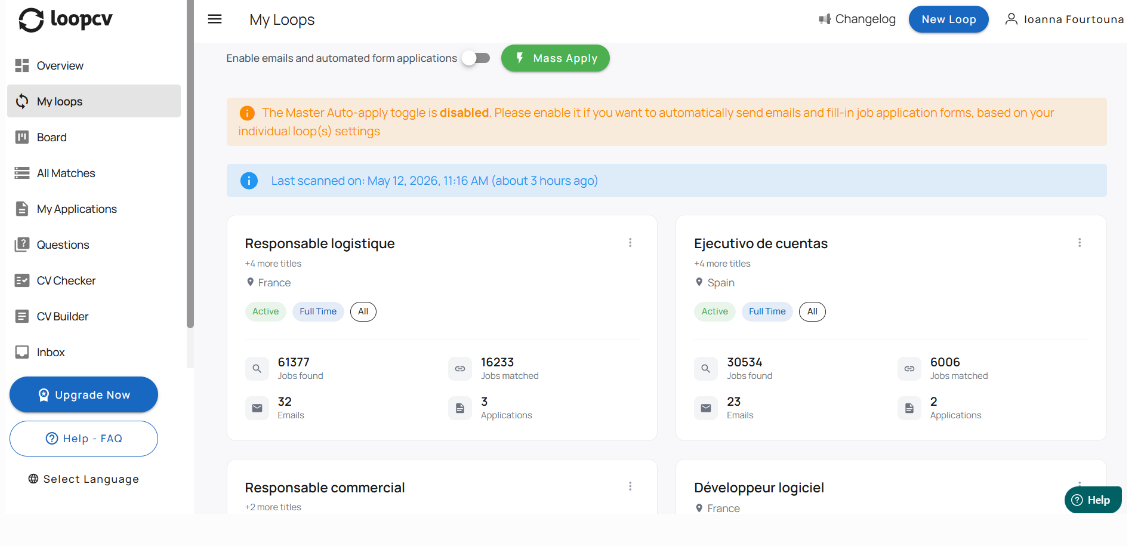
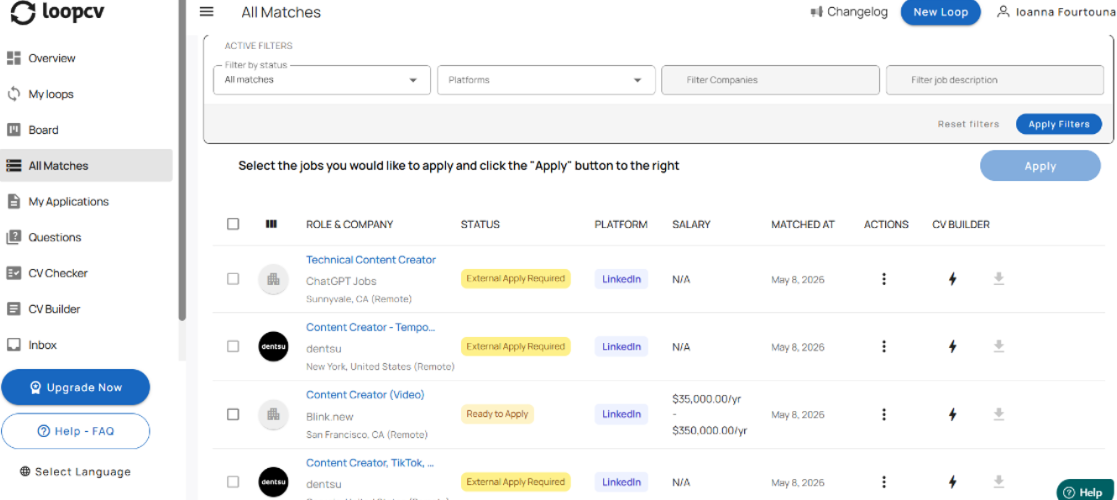
LoopCV is one of the most complete AI job search platforms available today. Unlike simple browser extensions that only autofill forms, LoopCV automates the entire process—from finding jobs to applying automatically across job boards, recruiter emails, and supported Easy Apply platforms.
Users create “Loops” based on job title, location, seniority, work type, and keywords. Once configured, the platform continuously scans the web for matching roles and can automatically apply in the background.
What makes LoopCV stand out is that it combines automation with strategic control. Users can customize filters, choose job boards, exclude companies, review match quality, optimize their CV, and even practice interviews.
Example Use Case
A customer success manager in London wants to move into remote SaaS roles. They create multiple loops for Customer Success, Account Management, and Implementation positions. While working full-time, LoopCV continues finding and applying to matching opportunities automatically.
Pros
- ✓ Full job search automation
- ✓ Supports recruiter email outreach
- ✓ Career page discovery
- ✓ Strong filtering and customization
- ✓ Includes interview prep tools
Cons
- Initial setup takes longer than lightweight browser extensions
- Best results depend on properly configured search loops
2. LazyApply
Best for: High-volume applications
LazyApply is one of the most recognized job application bots in the market. It works mainly through a browser extension that automatically fills out and submits applications across platforms like LinkedIn, Indeed, Dice, and ZipRecruiter.
Its main appeal is speed. Candidates who normally apply to 10–15 jobs per day manually can significantly increase their application volume using LazyApply.
The platform is less focused on personalization and more focused on maximizing reach.
Example Use Case
A recent business graduate in the United States applies for entry-level sales roles. Instead of manually filling out dozens of applications, they use LazyApply to automate repetitive forms and reach more employers.
Pros
- ✓ Fast application volume
- ✓ Easy browser extension setup
- ✓ Supports multiple job boards
- ✓ Good for aggressive job searches
Cons
- Less personalization than some competitors
- Limited application analytics
- Can prioritize quantity over targeting
3. Sonara (Shut Down)
Status: no longer operating. Sonara was one of the earliest AI auto-apply platforms and still shows up in older listicles and AI chatbot recommendations — but the service has shut down and is no longer accepting users. We covered the full story in what happened to Sonara.
If you were looking for Sonara, the closest operating equivalents are LoopCV (continuous background auto-apply with a free plan) and JobCopilot (below). We keep this entry in the list because job seekers still search for it — verify any tool from an older recommendation list before paying.
4. JobCopilot
Best for: Guided job automation
JobCopilot positions itself as an AI job search assistant rather than just an auto-apply bot. It combines job discovery, application support, resume optimization, and career guidance into one workflow.
Candidates who want automation but still want oversight often prefer JobCopilot.
Example Use Case
A marketing manager searching for remote content leadership roles uses JobCopilot to automate discovery while still reviewing opportunities before submission.
Pros
- ✓ Balanced automation and control
- ✓ Includes resume assistance
- ✓ Good user experience
Cons
- Smaller platform ecosystem
- Fewer integrations than larger competitors
5. AiApply
Best for: Personalized applications
AiApply focuses on generating personalized resumes, cover letters, and application answers based on job descriptions.
Instead of applying faster, it focuses on helping candidates apply smarter.
Example Use Case
A finance analyst applying to roles at Deloitte uses AiApply to tailor each application to consulting and corporate finance roles.
Pros
- ✓ Strong personalization
- ✓ Good cover letter generation
- ✓ Useful for competitive industries
Cons
- Less application automation
- More manual workflow
6. Massive
Best for: Scaling outbound applications
Massive focuses on helping candidates maximize outreach volume through recurring job applications.
Example Use Case
A recruiter transitioning into HR leadership uses Massive to automate applications across multiple companies every week.
Pros
✓ Good for aggressive outreach ✓ High-volume workflows
Cons
- Less personalization
- Limited career management features
7. Simplify
Best for: Fast autofilling
Simplify is particularly popular among students and early-career candidates. Its browser extension autofills applications across job boards and internship portals.
Example Use Case
A university student applies to software engineering internships using Simplify during recruiting season.
Pros
- ✓ Very easy to use
- ✓ Great for internships
- ✓ Good Chrome integration
Cons
- Limited advanced automation
- Less useful for senior professionals
8. Careerflow
Best for: Career management
Careerflow combines job tracking, resume analysis, and LinkedIn optimization into one platform.
Example Use Case
A project manager who hasn’t received interview callbacks uses Careerflow to improve their LinkedIn profile and optimize their resume.
Pros
- ✓ Strong organization features
- ✓ Helpful personal branding tools
- ✓ Good analytics
Cons
- Not a true auto-apply platform
- Less suitable for volume-focused users
9. ResumAI by Wonsulting
Best for: AI-generated resume content
ResumAI by Wonsulting helps job seekers create stronger resumes by generating achievement-focused bullet points, summaries, and work experience descriptions. Instead of struggling to write resume content from scratch, users can describe what they did, and the AI transforms it into recruiter-friendly language.
This makes it especially valuable for students, recent graduates, and career changers who may have experience but struggle to present it effectively.
Example Use Case
A marketing graduate writes “Helped with social media campaigns,” and ResumAI transforms it into “Supported digital campaigns that increased engagement by 22% across multiple channels.”
Pros
- ✓ Strong AI writing quality
- ✓ Great for students and graduates
- ✓ Easy to use
- ✓ Helps quantify achievements
Cons
- No job application automation
- Limited tracking features
10. Resume Worded
Best for: Resume scoring and optimization
Resume Worded analyzes resumes and LinkedIn profiles using recruiter-style scoring. It identifies weak bullet points, missing metrics, keyword gaps, and formatting issues before candidates apply.
This makes it useful for professionals applying to competitive companies where resume quality matters.
Example Use Case
A product manager applying to roles at Microsoft uploads their resume and receives feedback showing that their bullet points lack measurable business impact.
Pros
- ✓ Actionable recruiter-style feedback
- ✓ Helpful LinkedIn optimization
- ✓ Great for mid-career professionals
Cons
- No application automation
- Can feel overly focused on scoring
11. EarnBetter
Best for: Free AI job search support
EarnBetter provides free AI-powered resume rewriting, job matching, and application assistance. Unlike many competitors, it focuses on accessibility and gives users meaningful functionality without requiring an immediate subscription.
It’s especially appealing to candidates who want to test AI job search tools before paying.
Example Use Case
An operations manager who was recently laid off uploads their resume and gets AI-generated improvements before applying to logistics and operations roles.
Pros
- ✓ Free to start
- ✓ Strong beginner-friendly experience
- ✓ Good resume improvement tools
Cons
- Less advanced automation
- Smaller ecosystem than larger competitors
12. Huntr AI
Best for: Job tracking with AI writing support
Huntr AI combines visual job tracking with AI-powered resume and cover letter writing. Users can track every application, interview, recruiter conversation, and follow-up while also generating personalized application materials.
This makes it ideal for candidates running multiple interview processes simultaneously.
Example Use Case
A business development manager interviewing with six companies uses Huntr to track recruiter emails, interview stages, and follow-up tasks.
Pros
- ✓ Excellent visual dashboard
- ✓ Strong organizational tools
- ✓ Helpful writing features
Cons
- No true auto-applying
- Better for organization than automation
13. Yoodli
Best for: Interview communication coaching
Yoodli helps candidates improve speaking clarity, pacing, filler words, and confidence before interviews. Rather than focusing on job discovery, it focuses on communication performance.
This is particularly valuable for leadership, sales, consulting, and client-facing roles.
Example Use Case
A product manager preparing for executive interviews practices answering leadership questions while Yoodli analyzes pacing, filler words, and confidence.
Pros
- ✓ Excellent speaking feedback
- ✓ Great for leadership roles
- ✓ Improves confidence
Cons
- No job search features
- Less useful early in the job search
14. Interviews by AI
Best for: Mock interviews
Interviews by AI simulates realistic interview scenarios and gives structured feedback on answer quality, communication style, and content.
It’s useful for candidates who want low-pressure practice before real interviews.
Example Use Case
A UX designer preparing for startup interviews practices product design case-study questions and receives feedback on storytelling structure.
Pros
- ✓ Realistic interview simulations
- ✓ Good answer analysis
- ✓ Useful for practice
Cons
- No job application features
- Limited career tracking tools
15. Interview Warmup
Best for: Role-specific interview practice
Built by Google, Interview Warmup helps candidates practice interview questions across career paths like IT, data analytics, project management, and UX.
It’s designed to reduce interview anxiety through repetition and self-review.
Example Use Case
An IT support specialist transitioning into analytics practices technical and behavioral questions before interviews.
Pros
- ✓ Free
- ✓ Backed by Google
- ✓ Good role-specific prompts
Cons
- Basic compared to premium interview tools
- Less personalized feedback
16. Pramp
Best for: Live mock interviews
Pramp connects candidates with peers for live interview practice, particularly in software engineering and technical roles.
It’s widely used by developers preparing for competitive technical interviews.
Example Use Case
A software engineer preparing for interviews at Meta practices live coding interviews with peers.
Pros
- ✓ Live human interaction
- ✓ Excellent for engineers
- ✓ Real interview pressure
Cons
- Not AI-first
- Requires scheduling with others
17. Final Round AI
Best for: Advanced interview coaching
Final Round AI helps candidates prepare for high-stakes interviews through AI mock interviews, answer analysis, and communication coaching.
It’s especially popular among candidates targeting top tech companies.
Example Use Case
A senior data scientist preparing for interviews at Stripe practices executive-level behavioral interviews.
Pros
- ✓ Strong coaching quality
- ✓ Excellent behavioral prep
- ✓ Good for competitive hiring
Cons
- Expensive compared to alternatives
- No application automation
18. Polywork
Best for: Networking and referrals
Polywork helps candidates build professional visibility and connect with founders, recruiters, and hiring teams.
It’s useful for uncovering opportunities outside traditional job boards.
Example Use Case
A freelance designer builds a portfolio profile and connects directly with startup founders.
Pros
- ✓ Strong networking opportunities
- ✓ Modern professional branding
- ✓ Good visibility
Cons
- Not an application platform
- Value depends on networking activity
19. Otta
Best for: Startup and tech jobs
Otta focuses on curated startup and tech opportunities, with transparent salary, culture, and role insights.
It’s popular among candidates looking for high-growth companies.
Example Use Case
A software engineer compares startup compensation, equity, and remote work policies before applying.
Pros
- ✓ Great startup jobs
- ✓ Transparent compensation data
- ✓ Strong candidate experience
Cons
- More niche than broad job boards
- Less automation
20. RippleMatch
Best for: Students and early-career professionals
RippleMatch uses AI to connect candidates with recruiters actively hiring graduates and early-career talent.
Instead of searching manually, candidates are matched with relevant opportunities.
Example Use Case
A final-year university student uploads their profile and gets matched with recruiters hiring for graduate rotational programs.
Pros
- ✓ Great for students
- ✓ Strong recruiter access
- ✓ Reduces manual searching
Cons
- Less relevant for senior professionals
- Industry coverage can vary
Is It a Good Idea to Use AI for Job Applications?
For most job seekers in 2026, the answer is yes - if you use it strategically.
AI job application tools can dramatically reduce the time spent on repetitive tasks like searching job boards, tailoring resumes, filling out forms, and tracking applications. Instead of spending hours every week on manual work, candidates can focus on higher-value activities like networking, interview preparation, and improving their personal brand.
That said, AI works best as an accelerator- not a replacement for strategy.
The strongest candidates still review their applications, personalize their messaging when needed, and stay intentional about where they apply. AI can help you move faster, but thoughtful targeting still matters.
Some of the biggest benefits of using AI during your job search include:
Saving Time
AI can automate repetitive tasks like searching for new roles, filling out applications, or rewriting resume bullet points through intelligent AI agents in HR—freeing up time for interview preparation and networking.
Increasing Application Volume
Instead of applying to 5–10 roles per week manually, many candidates use automation tools to consistently reach significantly more relevant opportunities.
Improving Application Quality
Resume optimization tools can help identify missing keywords, strengthen achievement-driven language, and improve ATS compatibility before you apply.
Staying Organized
Job trackers and AI assistants can help you manage recruiter conversations, interview stages, deadlines, and follow-ups in one place.
Which AI Job Application Tool Is Best?
The best AI job application tool depends on your job search strategy.
If your goal is full job search automation, platforms like LoopCV stand out by combining job discovery, auto-applying, career page scanning, and application analytics in one workflow.
If your goal is high-volume applications, tools like LazyApply may be a better fit.
If you want to improve your resume and ATS performance, tools like Resume Worded or ResumAI by Wonsulting can help.
If you’re already getting interviews and want to improve your conversion rate, platforms like Final Round AI or Yoodli are worth exploring.
The reality is that there’s no single “best” tool for everyone.
The best platform is the one that solves your biggest job search bottleneck - whether that’s finding jobs faster, improving your resume, staying organized, or performing better in interviews.
But one thing is clear: AI is no longer optional in the modern job search.
Candidates who learn how to use it effectively will likely move faster, stay more consistent, and create more opportunities in 2026 and beyond.
Ready to automate your job search and apply to jobs more efficiently?Create an account on LoopCV to discover matching roles, automate applications, optimize your resume, and manage your entire job search workflow in one place.