LinkedIn Message Templates for Job Applications: 14 Examples That Work
Applying for a job on LinkedIn can feel like a one-way process. A job is posted, hundreds of people apply, and the application can quickly disappear in the hiring pipeline.
A well-written LinkedIn message gives you another way to reach the right person, whether that's a recruiter, hiring manager, employee, or alumni connection.
The key is knowing who to message, when to message them, and what to say. The strongest messages are short, specific, personalized, and built around one clear reason for reaching out.
- The article provides 14 LinkedIn message templates for different job-search situations, including recruiter outreach, hiring-manager messages, referrals, networking, career changes, recent graduates, follow-ups, post-interview messages, external recruiters, and reaching out before a job is available.
- A strong LinkedIn message has four core elements: a specific reason for reaching out, a relevant connection, brief context about the candidate, and one clear next step. Messages should stay short rather than repeat the candidate's resume.
- Personalization should focus on genuine connection points, such as a recent post, company project, shared university, mutual connection, career background, professional interest, or the specific role being hired for.
- Different situations call for different approaches. Referral requests need context, career-change messages should highlight transferable skills, graduate messages can focus on education and projects, and recruiter messages should connect the candidate to relevant roles.
- Follow-ups should remain limited and purposeful. The article suggests giving the recipient time to respond, with 7–10 days as a reasonable starting point for many situations, and generally recommends one thoughtful follow-up rather than repeated messages.
- AI can help draft messages, using the job description, recruiter's profile, recent activity, resume, and personalization points. Human review remains important to make sure the message sounds natural and the details are accurate.
What makes a good LinkedIn message for a job application?
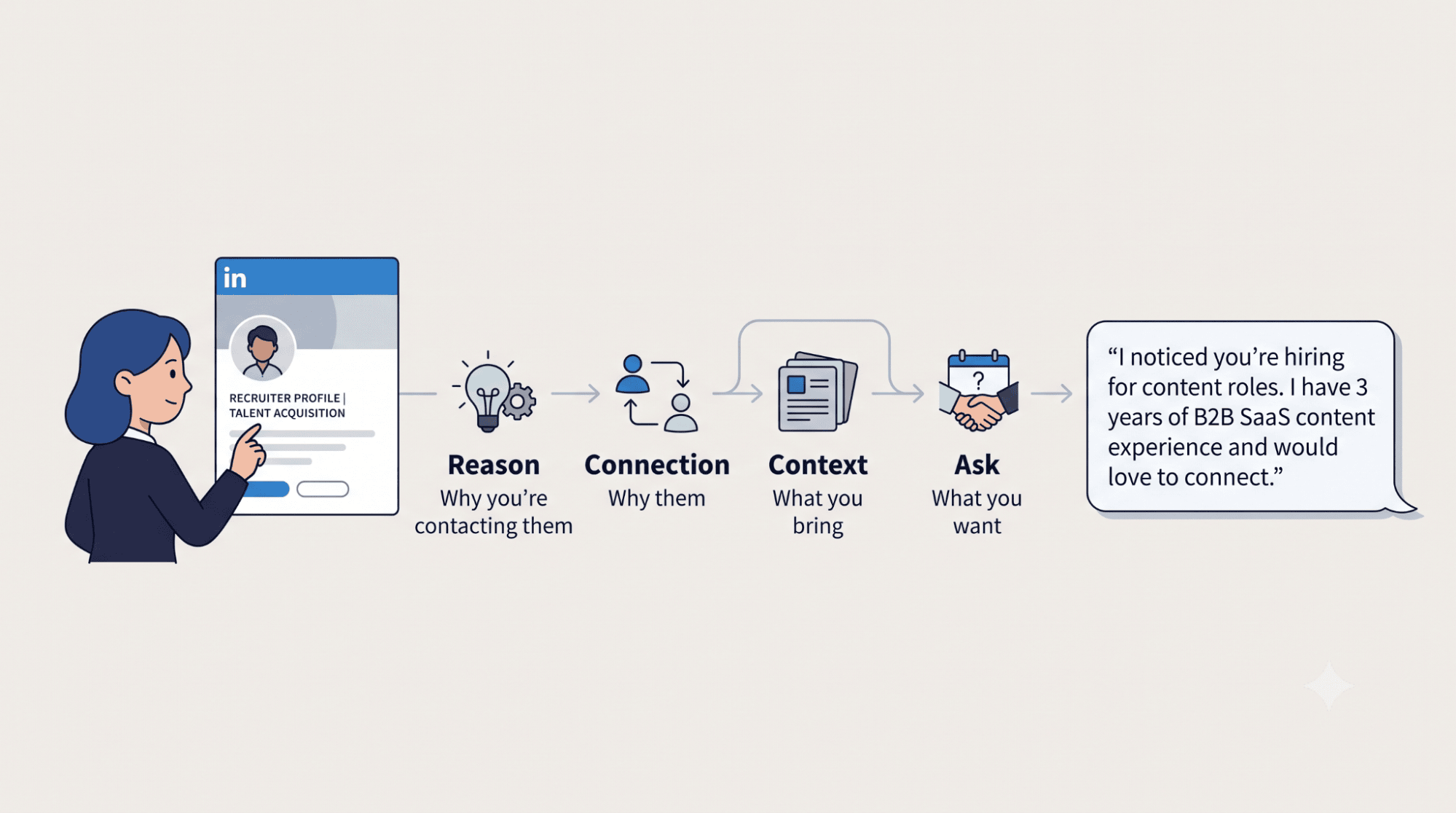
Before using a template, focus on four things:
- A specific reason for reaching out
- A connection to the recipient
- Relevant context about you
- One simple next step
For example:
Hi Sarah, I noticed you're recruiting for marketing roles at Acme and recently posted about the company's content team. I'm a content marketer with three years of experience in B2B SaaS and would love to connect and learn more about the team.
The message gives Sarah a clear reason to respond and enough context to understand who is reaching out.
How long should a LinkedIn job application message be?
Keep it short.
Connection requests have strict character limits, while regular LinkedIn messages give you more room. For regular messages, focus on the information the recipient actually needs.
A complete career history belongs in a resume, not a LinkedIn message.
1. LinkedIn Connection Request to a Recruiter
Use this when you've found a recruiter who regularly hires for your role or field.
The first message only needs to establish relevance. Save the detailed job discussion for later.
Template
Hi [Name],
I noticed you recruit for [role/field] at [Company]. I'm currently exploring opportunities in [field] and would love to connect and keep up with relevant openings. Thanks!
Example
Hi Sarah, I noticed you recruit for content and marketing roles at [Company]. I'm currently exploring content marketing opportunities and would love to connect and stay in touch.
Why it works
It tells the recruiter:
- Why you're contacting them
- What type of role you're looking for
- Why you want to connect
2. Message a Recruiter About a Specific Job
If you've already found an open position, mention the exact role and briefly connect it to your background.
Template
Hi [Name],
I saw the [Job Title] opening at [Company] and noticed that you're involved in hiring for [team/function]. I have [X years] of experience in [relevant skill] and recently applied for the role. I'd love to connect and learn more about the position and team.
Example
Hi Michael, I saw the SEO Content Manager opening at Acme and noticed you're part of the talent team. I have four years of experience in SEO content and recently applied for the role. I'd love to connect and learn more about the team.
The message connects your outreach to a real opening and makes your application status clear.
3. Message a Hiring Manager After Applying
A hiring manager can be worth contacting when their role is clearly connected to the position.
Research the company and find one genuine point you can mention rather than repeating the job description.
Template
Hi [Name],
I saw the [Job Title] opening at [Company] and noticed that you're involved in hiring for [team/function]. I have [X years] of experience in [relevant skill] and recently applied for the role. I'd love to connect and learn more about the position and team.
Example
Hi Michael, I saw the SEO Content Manager opening at Acme and noticed you're part of the talent team. I have four years of experience in SEO content and recently applied for the role. I'd love to connect and learn more about the team.
The message gives the hiring manager a reason to remember you beyond the application.
Knowing how to message a hiring manager after applying can also help when you're deciding who to contact and what to say.
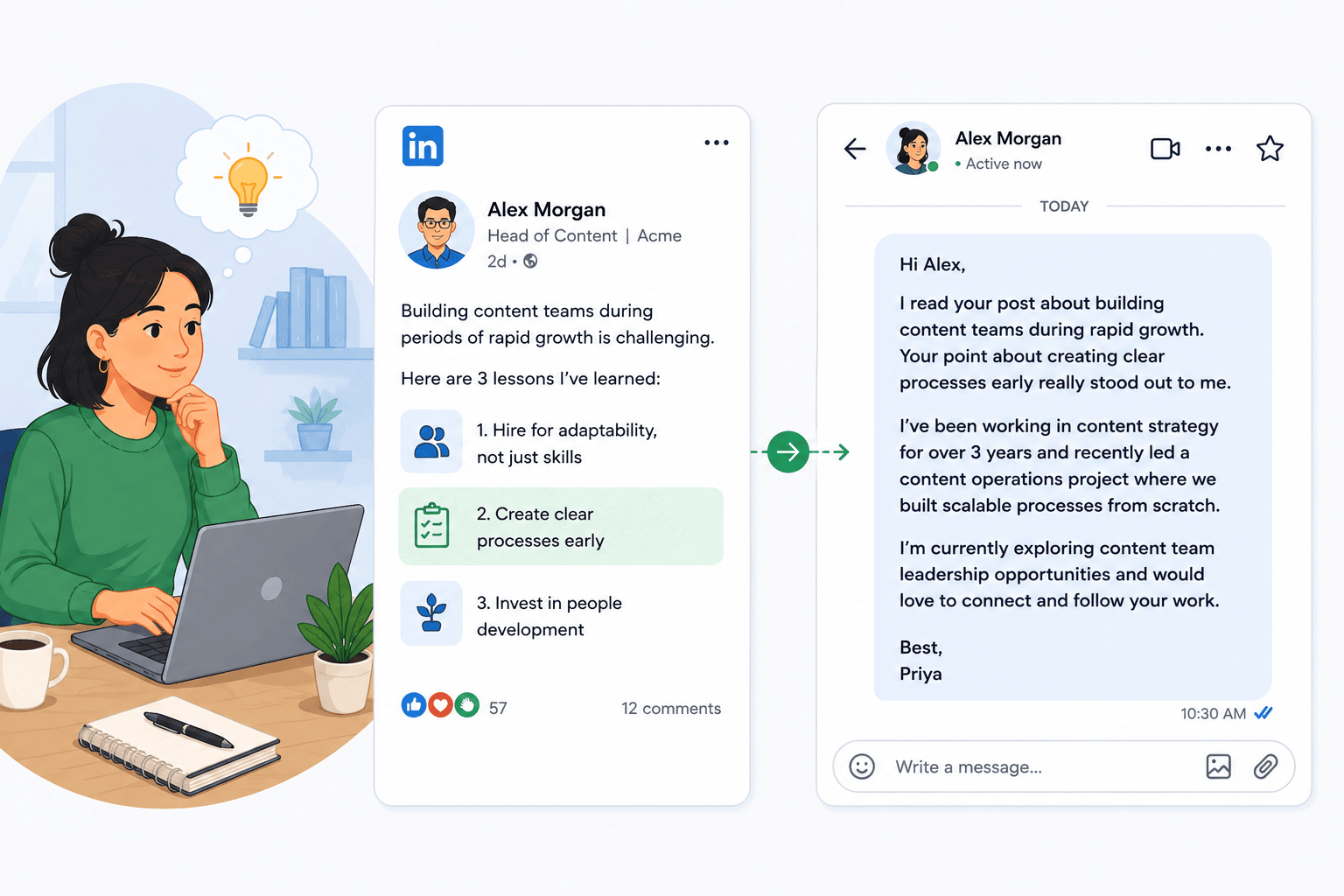
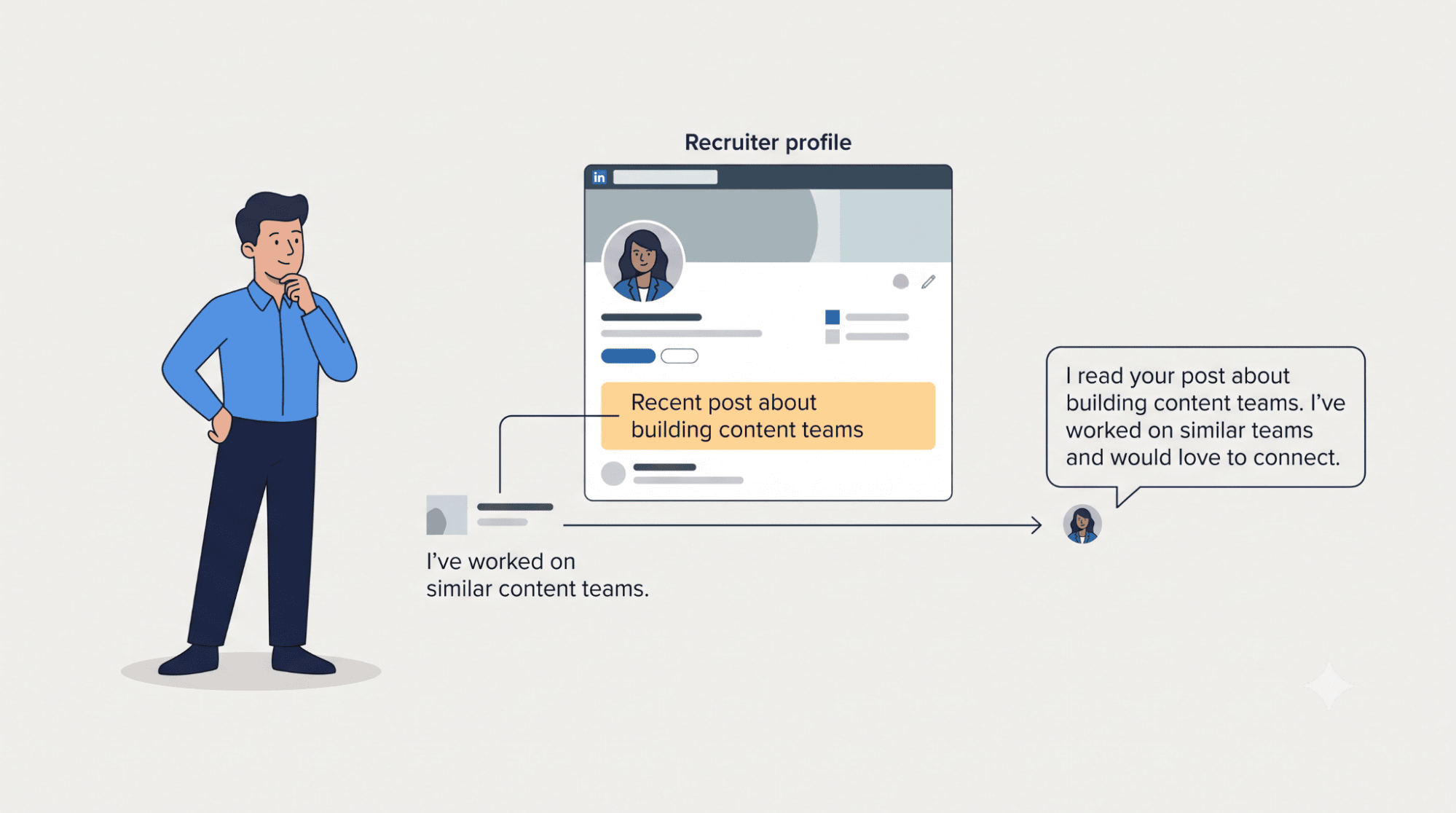
4. LinkedIn Message Based on a Recent Post
A person's recent LinkedIn activity can give you a natural starting point.
Choose one specific point from their post and connect it to your own experience or interests.
Template
Hi [Name],
I just read your post about [topic]. Your point about [specific point] caught my attention because I've been working on [related area]. I'm currently exploring opportunities in [field] and would love to connect and follow your work.
Example
Hi Alex, I read your post about building content teams during rapid growth. Your point about balancing specialist and generalist writers really stood out to me. I've worked on similar content teams and would love to connect.
A specific reference gives the recipient something to respond to. One outreach dataset found a 20% response rate for a specific post-based outreach example, though individual results will vary.
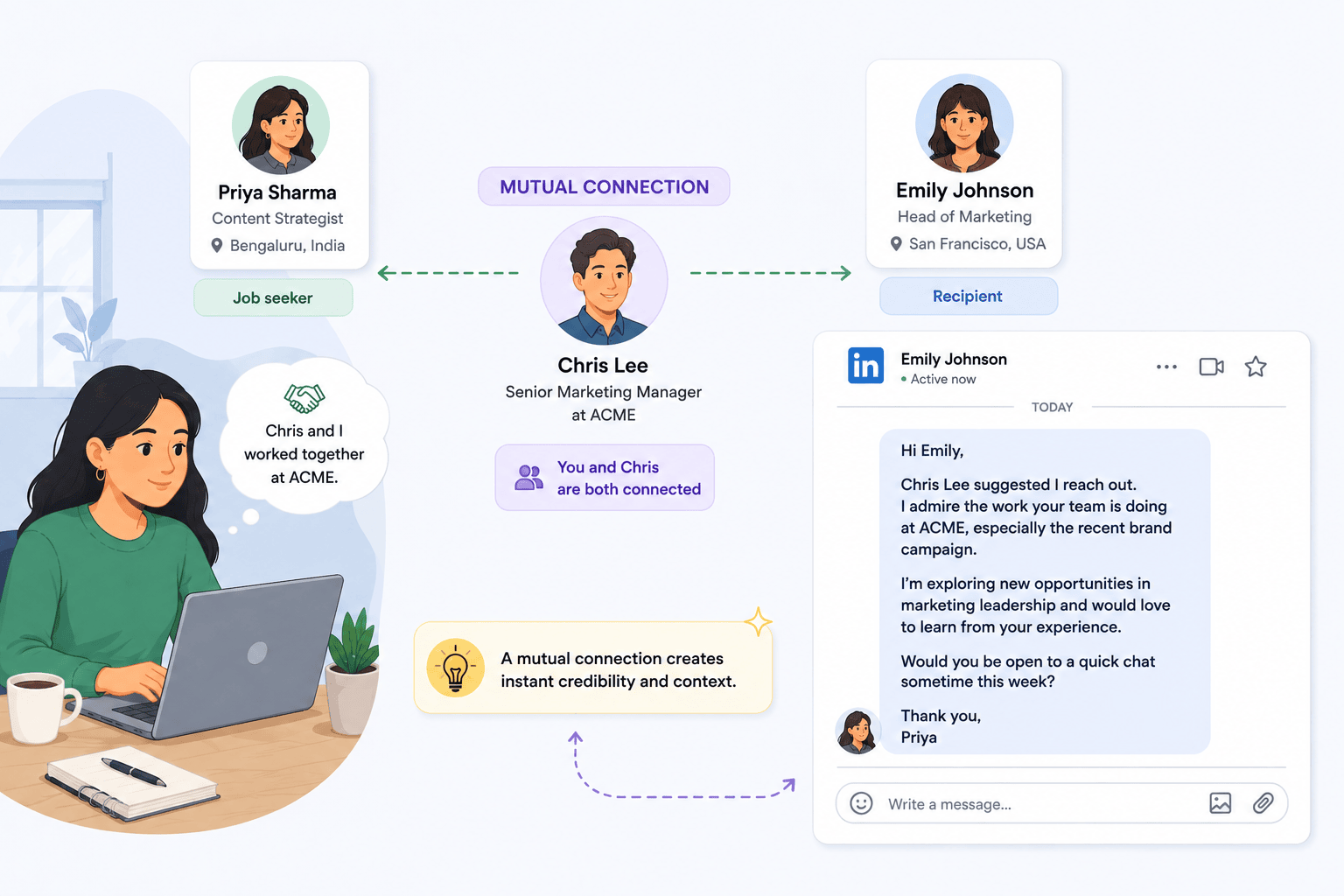
5. LinkedIn Message Through a Mutual Connection
A shared connection can give a cold introduction more context.
Before using someone's name, make sure the mutual connection is comfortable with it.
Template
Hi [Name],
[Mutual Connection] suggested I reach out. I'm currently exploring [role/field] opportunities and noticed your experience at [Company]. I'd love to connect and hear about your experience there when you have a chance.
Example
Hi Emily, Chris suggested I reach out. I'm currently exploring product design opportunities and noticed you've been working at [Company] for several years. I'd love to connect and hear about your experience there.
A mutual connection gives the recipient an immediate reason to understand why you're reaching out.
If the connection has already referred you to the role, the message should be adjusted accordingly, especially when introducing yourself after a referral.
6. LinkedIn Message to a Fellow Alumni
Your university or college gives you an easy reason to connect with someone you've never met.
This can work particularly well for students, recent graduates, career changers, and people targeting a specific company.
Template
Hi [Name],
I noticed we both attended [University]. I'm currently exploring opportunities in [field] and really liked the career path you've built at [Company]. Would love to connect and hear any advice you might have for someone entering the field.
Example
Hi Jessica, I noticed we both went to the University of Michigan. I'm currently exploring UX writing opportunities and saw that you've built your career in content design at [Company]. I'd love to connect and learn from your experience.
A shared university gives the conversation a natural starting point.
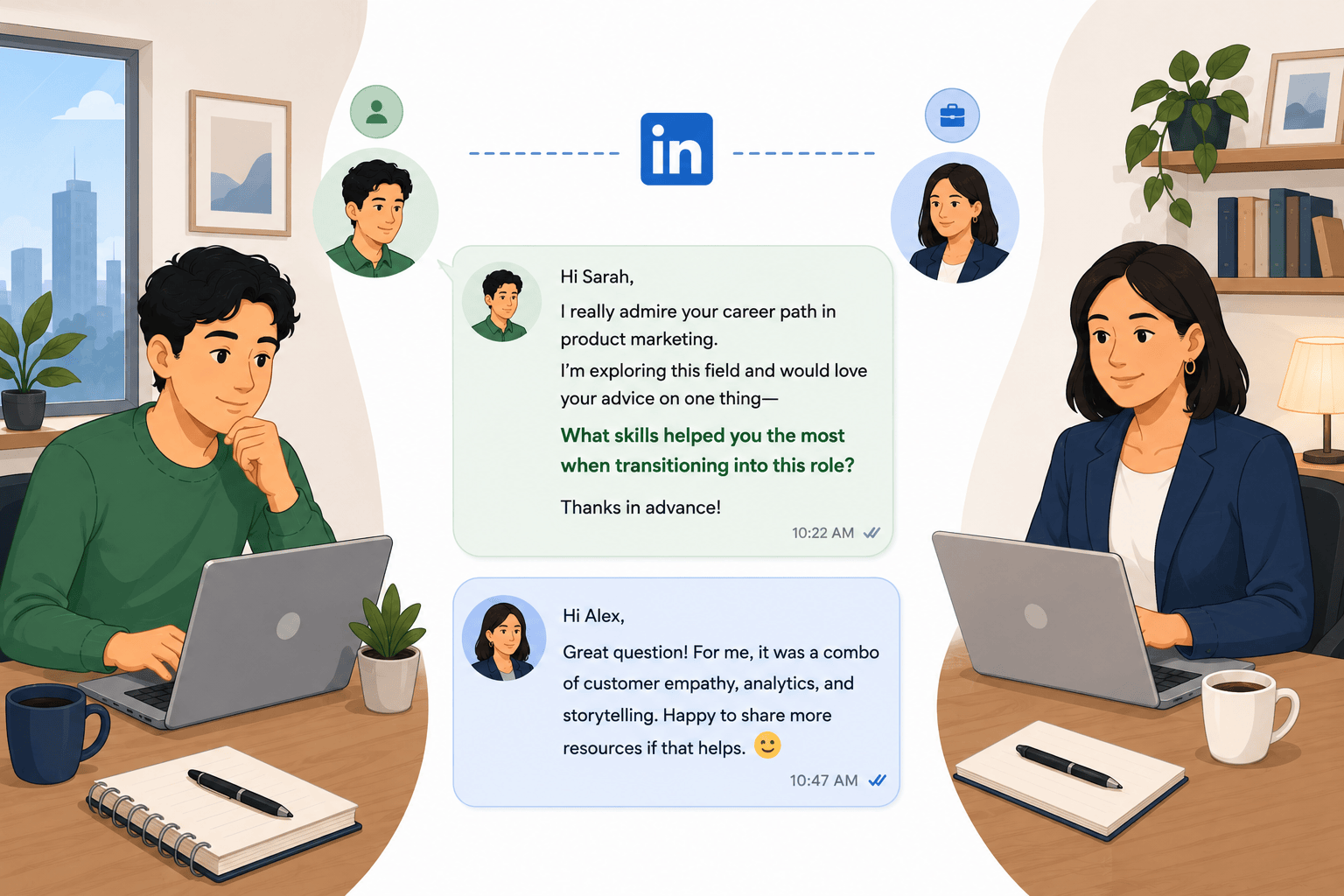
7. LinkedIn Message Asking for Career Advice
Sometimes the first conversation can focus on someone's experience rather than an open position.
This works particularly well when the person has a career path you are interested in.
Template
Hi [Name],
I'm currently exploring a move into [field/role], and your career path at [Company] caught my attention. If you have a few minutes, I'd love to ask how you got started in the field and what skills you think matter most today. Thanks for considering it.
Example
Hi Alex, I'm currently moving into product marketing, and your transition from content into product marketing caught my attention. If you have a few minutes, I'd love to hear what skills helped you make that transition.
Keep the ask small
A short question is easier to answer than a request for a meeting, referral, resume review, and job opportunity in the same message.
Be clear about what you want to learn and give the recipient enough space to respond.
8. LinkedIn Referral Request
A referral request usually works better when some context already exists, especially if the person knows you or you have a meaningful connection.
Template
Hi [Name],
I came across the [Job Title] opening at [Company], and I'm very interested in the role. My background in [relevant skill/experience] seems closely aligned with what they're looking for. If you're comfortable with it, would you be open to referring me or pointing me toward the right person on the hiring team? Happy to share my resume and any additional details.
Example
Hi Chris, I saw the Senior Content Writer opening at [Company]. I've spent the last four years working on B2B SaaS content, including several projects similar to the role requirements. If you're comfortable, would you be open to referring me or pointing me toward the right person on the team? Happy to share my resume and any additional details.
A referral is a request, not an expectation. Give the person an easy way to decline.
9. LinkedIn Message for a Career Change
Career changers need to connect their existing experience to the new field.
Focus on transferable skills rather than explaining your entire career transition.
Template
Hi [Name],
I'm currently transitioning from [current field] into [target field]. My experience in [transferable skill] has given me a strong foundation in [relevant area], and I'm now exploring opportunities in [target role]. I noticed your work at [Company] and would love to connect and learn more about the field.
Example
Hi Taylor, I'm transitioning from content marketing into product marketing. My experience in customer research, messaging, and go-to-market content has given me a strong foundation, and I'm now exploring product marketing roles. I'd love to connect and learn from your experience.
The strongest career-change messages connect existing skills to the requirements of the new field.
10. LinkedIn Message for a Recent Graduate
Recent graduates can focus on education, internships, projects, relevant skills, and genuine interest in the company.
Template
Hi [Name],
I recently graduated with a degree in [field], and I'm currently exploring entry-level opportunities in [role/field]. I've been following [Company], especially [specific project/news], and would love to connect and learn more about your experience there.
Example
Hi Emma, I recently graduated with a degree in computer science, and I'm exploring entry-level data analyst roles. I've been following [Company]'s work in analytics and would love to connect and learn more about your experience there.
The strongest part of this message is the connection between your background, the company, and the opportunity.
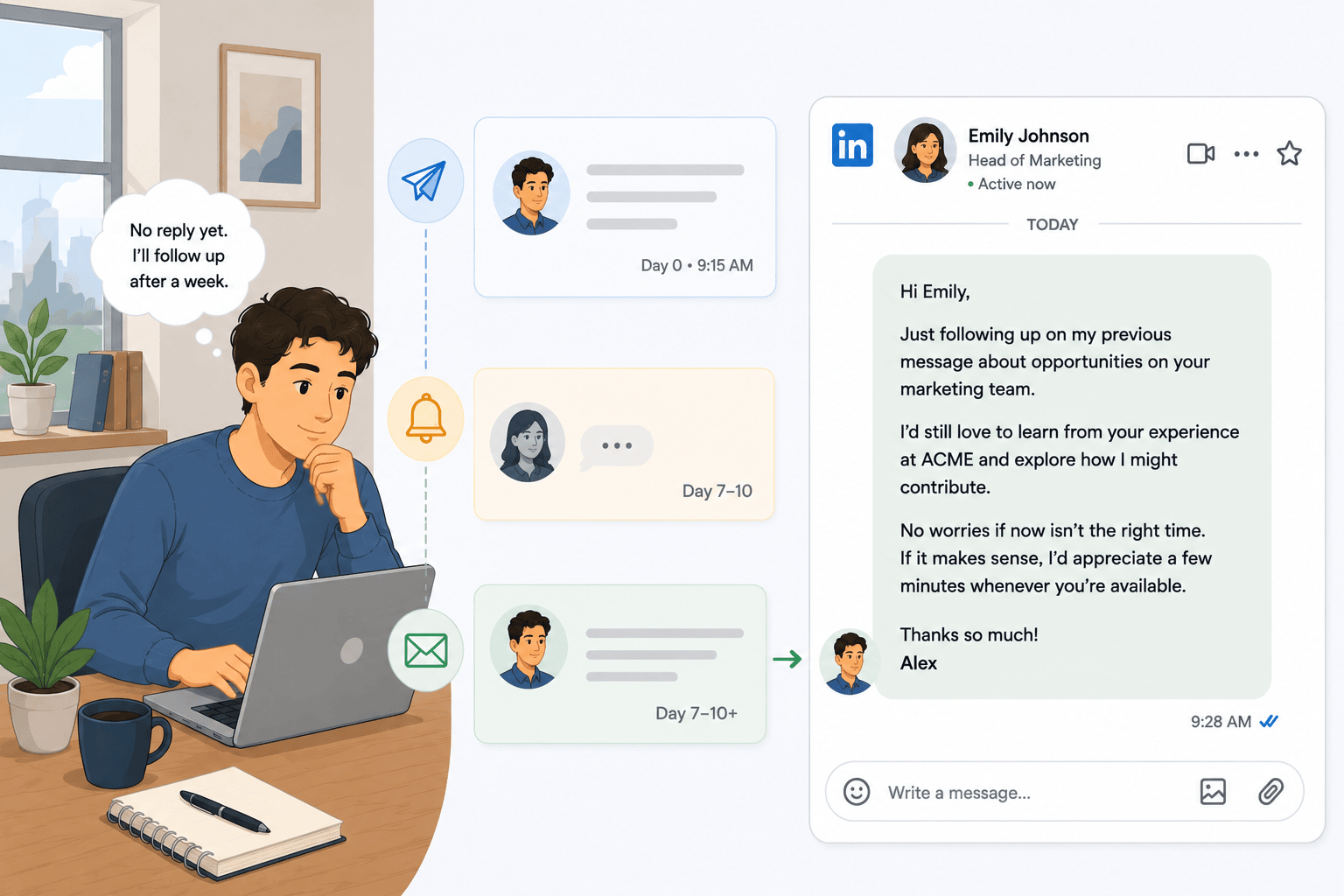
11. LinkedIn Follow-Up After No Response
A good first message can still get buried.
One polite follow-up can make sense when someone hasn't responded. Give them enough time and avoid sending a series of repeated messages.
Template
Hi [Name],
Just following up on my message about [role/topic]. I know LinkedIn messages can get buried, so I wanted to check in once. I'd still love to connect if you're open to it. Thanks!
Pro tip: LoopCV's Ghosted Recruiter Follow-Up Email Generator can help create a concise follow-up when a recruiter hasn't responded.
A more useful follow-up
If something relevant has changed since the first message, use that as the reason for following up.
A more useful follow-up
If something relevant has changed since the first message, use that as the reason for following up.
Hi [Name],
Following up on my earlier message about the [Job Title] role. I recently completed [relevant project/certification] and thought it might be useful context. I'd be glad to connect if you have a chance.
How long should you wait?
There is no universal follow-up window.
For most outreach, 7 to 10 days is a reasonable starting point. A message about an active job opening may justify a faster follow-up, while a general networking message can wait longer.
One thoughtful follow-up is usually enough.
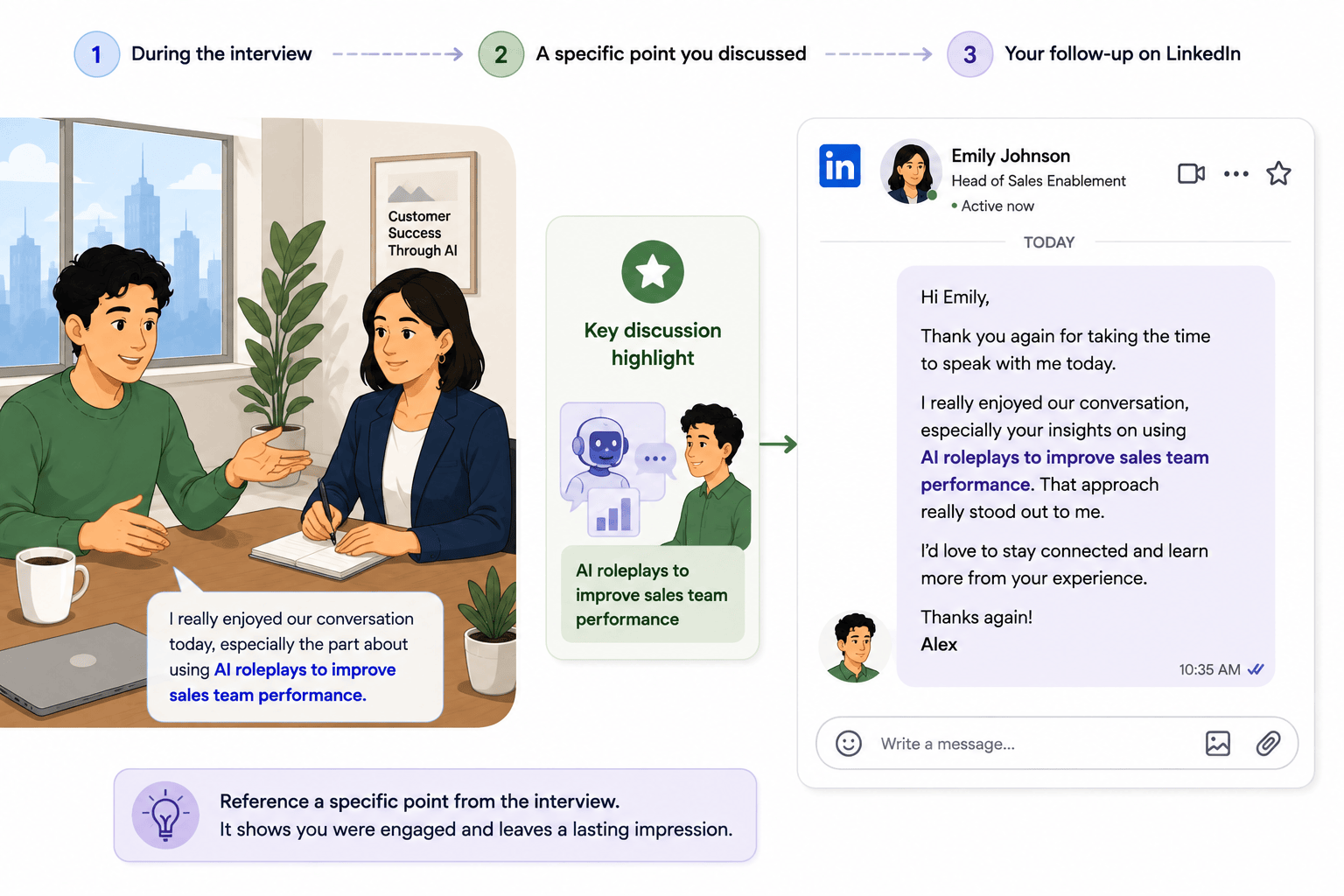
12. LinkedIn Message After an Interview
An interview gives you specific details to reference, which makes the follow-up easier to personalize.
Template
Hi [Name],
Thank you again for taking the time to speak with me about the [Job Title] role. I especially enjoyed our discussion about [specific topic]. It made me even more interested in the opportunity and the work your team is doing. Please let me know if I can provide anything else.
Example
Hi Chris,
Thank you again for speaking with me about the Growth Marketing Manager role. I especially enjoyed our discussion about expanding the content acquisition channel. It made me even more interested in the opportunity and the direction of the team. Please let me know if you need anything else from me.
13. LinkedIn Message to an External Recruiter
External recruiters often work across several companies, so focus on your profile and the types of roles you're targeting.
Template
Hi [Name],
I noticed you specialize in recruiting for [role/industry] in [location]. I'm currently exploring opportunities in [field] and have experience in [2 relevant skills]. I'd love to connect and stay in touch for relevant opportunities.
Example
Hi Sarah, I noticed you specialize in recruiting product and growth marketing professionals in SaaS. I'm currently exploring product marketing roles and have five years of experience across B2B SaaS content and go-to-market projects. I'd love to connect and stay in touch.
Resume Worded recommends clearly stating your background and what you're looking for when contacting external recruiters.
14. LinkedIn Message When There Is No Open Job
You can also reach out before a suitable job appears.
If a company is high on your target list, connect with someone there and start building a relationship before a relevant position opens.
Template
Hi [Name],
I've been following [Company] and really liked [specific initiative/project]. I'm a [role] with experience in [skill], and I'm interested in the kind of work your team is doing. I'd love to connect and stay in touch about future opportunities.
This approach works best when you have a genuine interest in the company and can mention something specific about its work.
How to Personalize a LinkedIn Message in 3 Steps
Templates save time, but sending the same message to 50 people rarely produces strong outreach.
A simple personalization process works better.
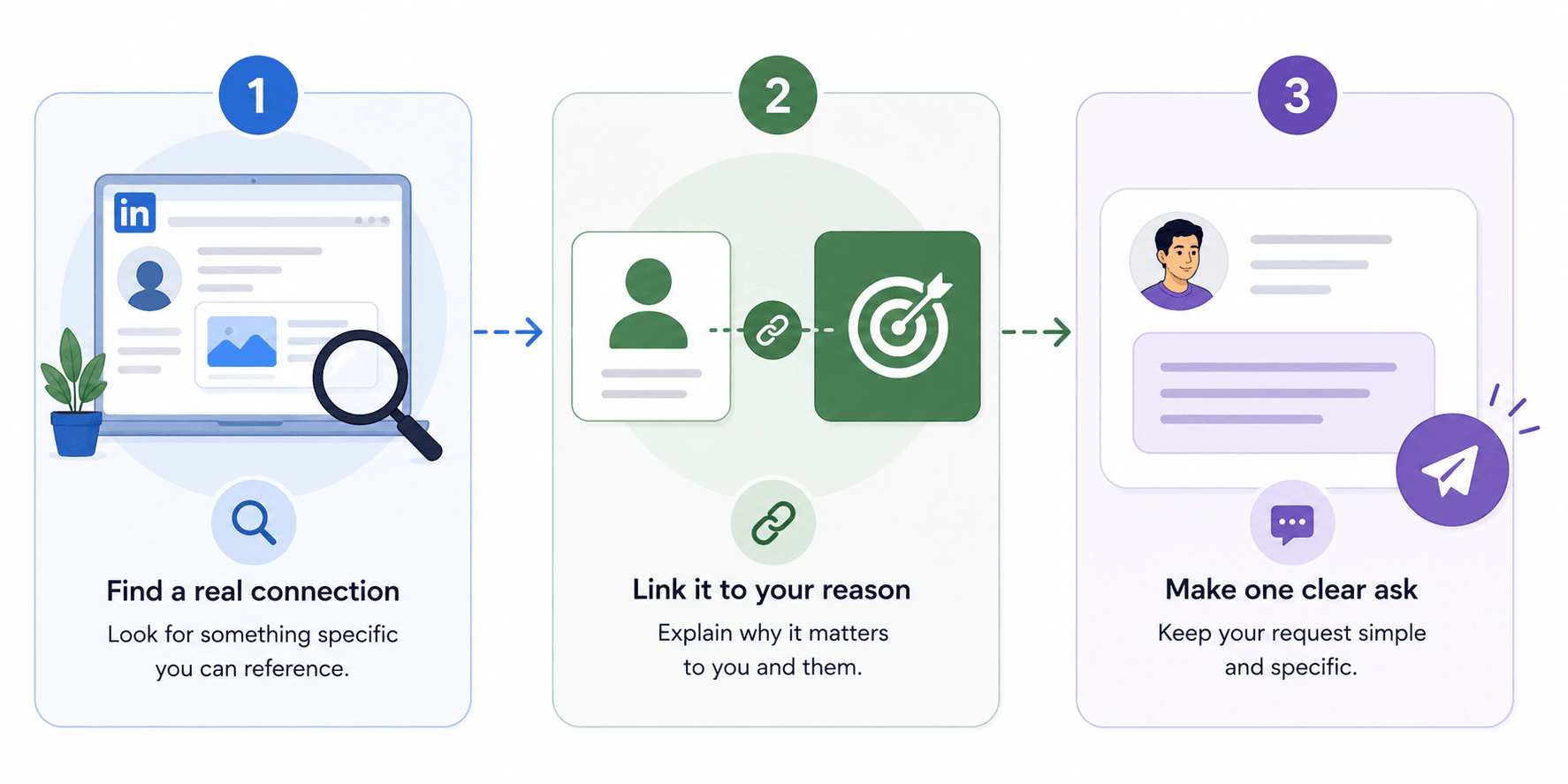
Step 1: Find one real connection point
Look at:
- Their current role
- Recent LinkedIn posts
- Company projects
- Career background
- Shared university
- Mutual connections
- Previous companies
- Professional interests
- The role they are hiring for
You only need one or two relevant details.
Your own profile matters too. Make sure your headline and summary clearly support the type of roles you're targeting. A strong LinkedIn profile for job searching gives the person you're contacting useful context when they check your profile.
Step 2: Connect that detail to your reason for reaching out
Weak:
“I saw your profile and would like to connect.”
Better:
“I noticed you recruit for product marketing roles at [Company], and I'm currently exploring opportunities in that area.”
Stronger:
“I noticed you recently shared the launch of [product]. I've worked on go-to-market content for similar SaaS products and am currently exploring product marketing opportunities.”
The third version gives the recipient a specific reason to engage.
Step 3: Make one clear ask
Choose one:
- Connect
- Ask a short question
- Learn about their experience
- Ask about a specific role
- Request a referral
- Ask whether they are the right person to contact
Keep the message focused on one request.
What Not to Say in a LinkedIn Job Application Message
Some messages make the recipient do too much work.
1. Avoid: "Please find me a job"
Hi, I'm looking for a job. Please let me know if your company has any openings.
Try: I'm currently exploring content marketing roles and noticed you're hiring for several positions in that area. I'd love to connect and stay in touch.
2. Avoid: A complete resume in the message
Your LinkedIn message doesn't need to repeat your entire work history.
Try: I have four years of experience in B2B SaaS content, with a focus on SEO and product-led content.
3. Avoid: Generic compliments
Your profile is amazing, and your career is inspiring.
Try: I saw your post about building an SEO team and found your approach to content operations particularly interesting.
4. Avoid: Asking for too much immediately
Can you refer me, review my resume, introduce me to the hiring manager, and schedule a call?
Start with one request.
Avoid: Repeated follow-ups
One polite follow-up is usually enough. Kondo specifically recommends avoiding multiple follow-ups because they can come across as pushy.
Does Personalization Actually Improve LinkedIn Messages?
Personalization can help, but the data doesn't show that it always leads to more connection requests being accepted.
Personalized connection notes had almost no effect on acceptance rates: 26.42% vs. 26.37%. However, reply rates were higher when a message was included: 9.36% vs. 5.44%.
This suggests that the value of personalization may come after the connection, when there is an opportunity to start a real conversation. A specific role, shared connection, recent post, or relevant experience gives the recipient something meaningful to respond to.
The takeaway: give the recipient a genuine reason to respond.
Can AI Help Write LinkedIn Messages?
Yes. AI can help turn information about the person, company, role, and candidate into a concise first draft.
Useful inputs include:
- The job description
- The recruiter's LinkedIn profile
- A recent post from the recruiter
- Your resume
- Relevant experience
- Your preferred tone
- The goal of the message
Then ask the AI to create a short message using only those details.
Prompt
Write a LinkedIn message to a recruiter for the role below.

Recruiter: [Name and role]
Company: [Company]
Job: [Job title]
My background: [2-3 relevant details]
Personalization point: [recent post, company project, mutual connection, etc.]
Goal: [connect/ask about role / follow up after applying]
Keep it under 100 words. Make it natural, specific, professional, and conversational. Do not use generic praise or exaggerated language.
Pro tip: LoopCV's LinkedIn Message Generator can help create drafts for connection requests, InMails, referral requests, and follow-ups.
Human review still matters. AI can produce grammatically correct messages that feel generic or overly polished. Check whether the message sounds like something you would actually say and whether every personalized detail is accurate.
How LoopCV Can Fit Into a LinkedIn Job Search
LinkedIn messaging works best alongside the rest of the job search, including finding jobs, tailoring resumes, applying, tracking applications, identifying relevant contacts, and following up.
LoopCV can automate several of the repetitive parts of that workflow while leaving the networking and final messaging decisions with the job seeker.
A practical workflow could look like this:
- Find relevant jobs based on your target role, location, and preferences.
- Tailor your resume to each relevant position.
- Submit and track applications so opportunities stay organized.
- Identify the right LinkedIn contact at the company.
- Find one personalization point before sending a message.
- Use AI to draft the message based on the relevant details.
- Edit the message yourself so it sounds natural.
- Send one thoughtful follow-up when appropriate.
- Track conversations and responses alongside your applications.
The goal is to reduce repetitive application work while keeping networking personal.
A Simple LinkedIn Messaging Formula
When you need a starting point, use:
Context + Connection + Relevance + Small Ask
For example:
Hi [Name],
I saw your recent post about [topic] and noticed you're working on [specific area] at [Company]. I'm a [role] with experience in [relevant skill], and I'm currently exploring [type of opportunity]. I'd love to connect and learn more about your experience.
Each part has a clear purpose:
- Context: Why are you contacting this person?
- Connection: What specific detail makes the message relevant?
- Relevance: Why does your background connect to the conversation?
- Small ask: What would you like them to do?
Final Takeaway
A LinkedIn message is a small part of a job application, but it can create another opportunity to be seen and start a conversation.
Keep the message short, specific, and relevant to the person receiving it. Mention a real reason for reaching out, connect it to the role or your career goal, and make one simple request.
Use templates as a starting point and personalize the details that matter. The recipient should quickly understand who you are, why you're contacting them, and what you're asking for.
LinkedIn messaging can also sit alongside tools such as LoopCV, which can handle repetitive application tasks while networking and relationship-building remain personal.
FAQs
Should I message a recruiter after applying for a job?
Yes, when the recruiter is clearly connected to the role, and you have something relevant to say. Mention the position, briefly explain your background, and make a simple request.
Should I message the hiring manager on LinkedIn?
You can, especially when you've identified the person responsible for the team or role. Research their work first and keep the message focused on the position and your relevant experience.
What should I say to a recruiter on LinkedIn?
Start with why you're contacting them. Mention the role or type of roles you're interested in, add one relevant detail about your background, and finish with a simple request such as connecting or learning more.
How long should a LinkedIn job application message be?
Keep it short. Connection requests have strict character limits, while regular messages allow more space. Even with more room, focus on the information the recipient needs.
Should I follow up if a recruiter doesn't respond?
One polite follow-up can be appropriate. Give the recruiter enough time to respond and avoid sending several messages in a row. Timing depends on the situation, with sources recommending anything from a few days to one or two weeks.
Can I use the same LinkedIn message for every recruiter?
Use a reusable structure and personalize the important details. The person's role, company, recent activity, target job, and your reason for contacting them should shape the final message.
Should I ask for a referral in the first message?
It depends on the relationship. If the person already knows you or there is a strong connection, a referral request can make sense. With a completely cold contact, starting with a connection or a small question can make the conversation more natural.