
AI Job Agent: What It Is and How to Set One Up for Your Job Search
The average job search takes 3 to 6 months. Most of that time is not spent interviewing. It's spent writing the same information into application forms, tailoring the same resume, and tracking down the same status updates, over and over again.
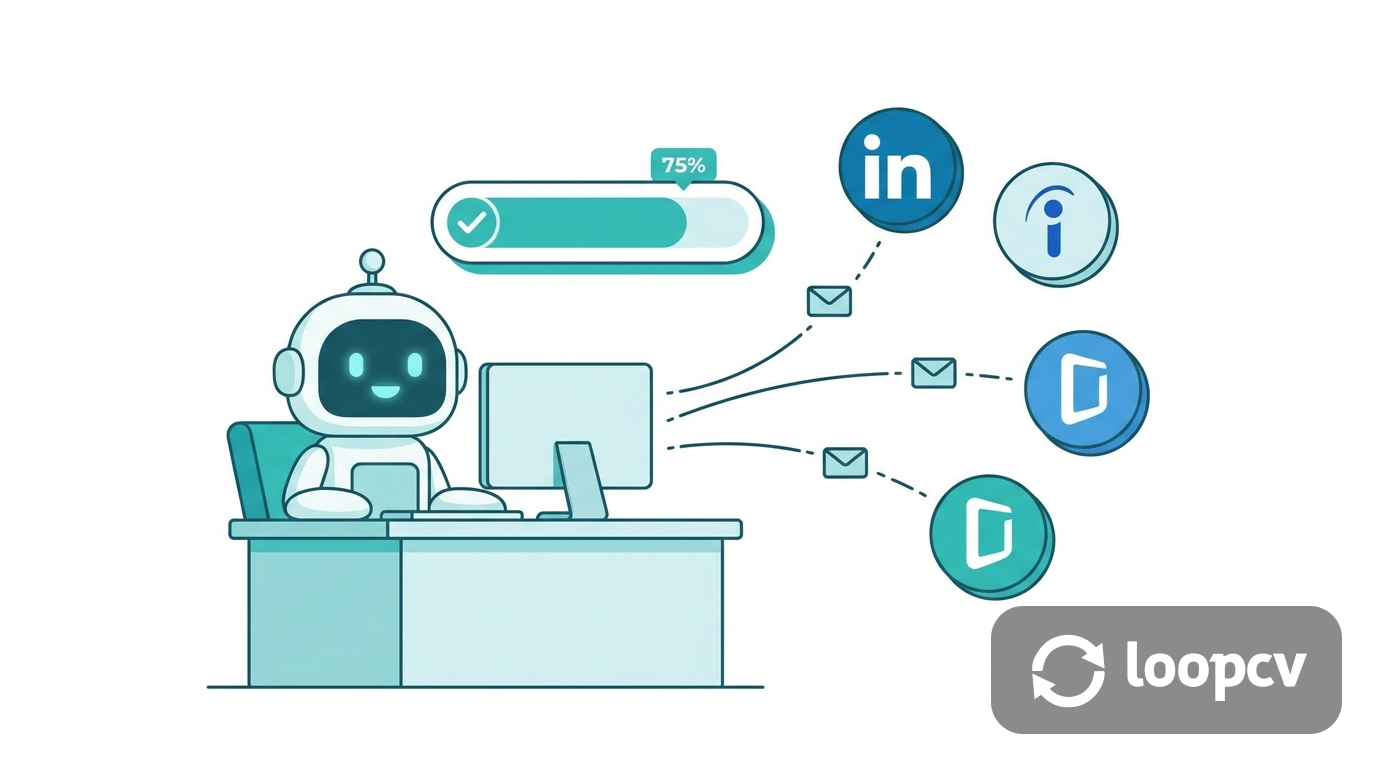
An AI job agent changes that. Instead of you doing the repetitive work, the agent does it for you: finding matching jobs, submitting applications, and keeping your search running in the background while you focus on preparing for interviews.
Here's what an AI job agent actually is, how it works, and how to set one up.
An AI agent is one of several tool categories worth knowing; our overview of AI tools for job search maps the full landscape.
What Is an AI Job Agent?
An AI job agent is software that automates the mechanical parts of job searching — LoopCV's own job application agent is a working example of the category in production. At minimum, it can find job listings that match your profile and apply to them automatically. More advanced agents can tailor your resume per role, track your applications across platforms, and even send follow-up messages on your behalf.
The term "agent" is intentional. Unlike a simple job alert that emails you a list, an AI job agent takes action. It doesn't just find jobs; it applies to them. It doesn't just notify you; it works.
Think of it as the difference between a job board and a job search assistant who works for you 24/7, submitting applications on your behalf across every major platform while you sleep.
What Can an AI Job Agent Do?
Depending on the tool, an AI job agent can handle some or all of the following:
- Automated job discovery: scans job boards (LinkedIn, Indeed, Glassdoor, and others) continuously for new postings that match your target role, location, and salary
- Resume tailoring: adjusts your resume keywords and summary to match each job description before applying
- Automated applications: fills in and submits applications across multiple platforms without you having to open each one
- Application tracking: logs every application sent so you know where you've applied and when
- Follow-up scheduling: some agents can flag when to follow up or send automated follow-up emails
- ATS optimization: checks that your resume passes applicant tracking system filters before submitting
The core value is volume plus targeting. A manual job seeker can realistically apply to 5 to 15 jobs per day before burning out. An AI job agent can apply to hundreds of targeted roles in the same time, without the fatigue.
How Is an AI Job Agent Different from a Job Alert?
| Job Alert | AI Job Agent | |
|---|---|---|
| Finds jobs | Yes | Yes |
| Applies to jobs | No — you do it | Yes — automatically |
| Tailors resume per role | No | Yes (advanced tools) |
| Tracks applications | No | Yes |
| Works while you sleep | No | Yes |
| Covers multiple platforms | One at a time | 30+ simultaneously |
How to Set Up an AI Job Agent: Step by Step
Step 1: Optimize Your Resume First
An AI job agent can apply to hundreds of jobs for you, but it can only work with the resume you give it. Before you turn the agent on, make sure your resume is ATS-optimized: clean formatting, strong keywords, measurable bullet points, and a score above 80 on a free ATS checker.
LoopCV's free AI resume checker gives you an instant score and flags exactly what to fix before you start applying at scale. Getting this right first means every application the agent sends goes out with a resume that actually passes filters.
Step 2: Define Your Target Job Profile
A well-configured job agent needs to know what you're looking for. Before setting it up, be specific about:
- Job titles: list all the titles you'd accept (e.g. "Product Manager," "Senior PM," "Group Product Manager")
- Location: remote, specific cities, or willing to relocate
- Salary range: minimum acceptable, not just your target
- Industries: sectors you want to work in or are willing to exclude
- Company size: startup, mid-size, enterprise, or no preference
- Job type: full-time, contract, part-time
The more precise your target profile, the better the agent's matching. A vague profile leads to irrelevant applications that waste your time on the wrong interviews.
Step 3: Choose Your AI Job Agent Tool
The leading AI job agent for most job seekers is LoopCV. Here's why it stands out:
- Applies automatically to matching jobs across 30+ platforms including LinkedIn, Indeed, Glassdoor, Monster, and more
- Runs daily on a schedule, so applications go out consistently without you logging in
- Integrates directly with the free ATS checker, so you can optimize your resume and immediately put it to work
- Lets you set filters for role, location, salary, and seniority level so only relevant jobs get applications
- Tracks every application in a dashboard so you always know your numbers
Other options exist (LazyApply, JobCopilot, AIApply), but LoopCV is the only one that combines ATS resume checking with full automated application across this many platforms in one workflow.
Step 4: Configure and Launch
Once you've chosen your tool, the setup process typically takes 15 to 30 minutes:
- Upload your optimized resume
- Set your job preferences (title, location, salary, type)
- Choose which platforms to apply on
- Set your daily application volume or let the agent run at full capacity
- Review the filter settings and launch
After launch, the agent runs automatically. Most tools send you a daily or weekly summary of applications submitted.
Step 5: Monitor and Adjust
An AI job agent is not a "set it and forget it" solution. Check your dashboard every few days to review:
- Which roles are generating interview requests (these are the sweet spots)
- Which roles are getting no responses (may need resume tweaks or title adjustments)
- Whether the job matches feel right for your level and target
If you're getting lots of applications out but few callbacks, the issue is usually your resume or your target job profile, not the agent. Tighten either one and re-run.
Who Benefits Most from an AI Job Agent?
AI job agents work best for:
- Active job seekers who need to generate volume fast, particularly those recently laid off or with a hard deadline
- Passive job seekers who want to stay in the market without spending hours on applications every week
- Career changers applying broadly across a new field to see what lands
- Early-career candidates competing in high-volume markets where speed and volume matter
They work less well for very senior or niche roles where relationships and referrals matter more than volume. At the executive level, most roles aren't posted publicly. For director and above, a targeted networking approach often outperforms mass applications.
Common Mistakes to Avoid
Launching before your resume is ready
The agent multiplies whatever you give it. A weak resume sent to 500 jobs gets 500 rejections. Optimize first, then scale.
Setting filters too broad
A job agent that applies to everything you're remotely qualified for will generate noise: interviews for roles you don't actually want, at companies that don't fit. Be specific in your filters and treat irrelevant interviews as a signal to tighten them.
Ignoring the application log
If a recruiter calls about a role you applied to three weeks ago, you need to know the context. Check your application log before every call and keep notes on roles you're interested in.
Applying to the same companies repeatedly
Most platforms flag duplicate applications. Configure your agent to avoid re-applying to companies where you already have an active application.
Frequently Asked Questions
Is it OK to use an AI agent to apply for jobs?
Yes. Using an AI job agent is no different from using any other job search tool. Employers post jobs publicly specifically to receive applications. An AI agent simply submits those applications faster and more consistently than doing it manually. The application itself still comes from you: your resume, your qualifications, your profile.
Will companies know I used an AI agent to apply?
No. Employers receive your application and resume through their standard ATS, the same as any other application. The method you used to submit it is not visible to them. What matters is whether your resume is strong and relevant, not how it was submitted.
How many jobs should an AI agent apply to per day?
For most active job seekers, 20 to 50 targeted applications per day is a reasonable starting point. More is possible, but quality of match matters more than raw volume. An agent applying to 200 loosely matched jobs per day will generate fewer useful interviews than one applying to 30 well-matched roles.
What is the best AI agent to apply for jobs?
LoopCV is the most comprehensive option for most job seekers, combining free ATS resume checking with automated applications across 30+ job platforms. It covers more platforms than most competitors and integrates resume optimization directly into the workflow. Other tools include LazyApply, JobCopilot, and AIApply, but none offer the same combination of reach and resume checking in one place.
Can an AI job agent get me interviews faster?
Yes, when used correctly. The main bottleneck in most job searches is application volume. Most job seekers send too few applications and wait too long between them. An AI agent that sends 20 to 50 targeted applications per day, consistently, over several weeks, generates significantly more interview opportunities than a manual search producing 5 to 10 applications per week. Speed of results still depends on your resume quality, the competitiveness of your target roles, and market conditions.