
How to Find the Must-Have Requirements in a Job Description With AI
Before applying for a job, it helps to know which requirements actually matter to the hiring decision. A posting might ask for five years of experience, a specific certification, three software tools, and several additional skills. Missing one of them doesn't always mean the application should be ruled out.
The important distinction is between a requirement that can genuinely prevent a candidate from being considered and one that describes the employer's preferred background. That distinction isn't always obvious from a quick read of the job description, especially when mandatory qualifications and desirable skills are listed together.
AI can make this easier by breaking down the posting, identifying language that signals a must-have requirement, and comparing those requirements with the candidate's background. The result is a clearer picture of which gaps are worth worrying about and which ones shouldn't stop an application from moving forward.
Here's how to identify those non-negotiable requirements before spending time on an application.
- Job descriptions often combine mandatory requirements, preferred qualifications, and general responsibilities.
- Words such as "required," "must have," and "minimum" can signal that a qualification is essential.
- Some non-negotiable requirements are practical rather than professional, such as work authorization, location, or schedule.
- AI can organize a job description into must-have, preferred, and general requirements.
- A missing preferred qualification doesn't necessarily make a candidate unsuitable.
- A missing mandatory requirement may be a strong reason to reconsider an application.
- AI should support the decision-making process, not make the final application decision.
What are non-negotiable requirements in a job description?
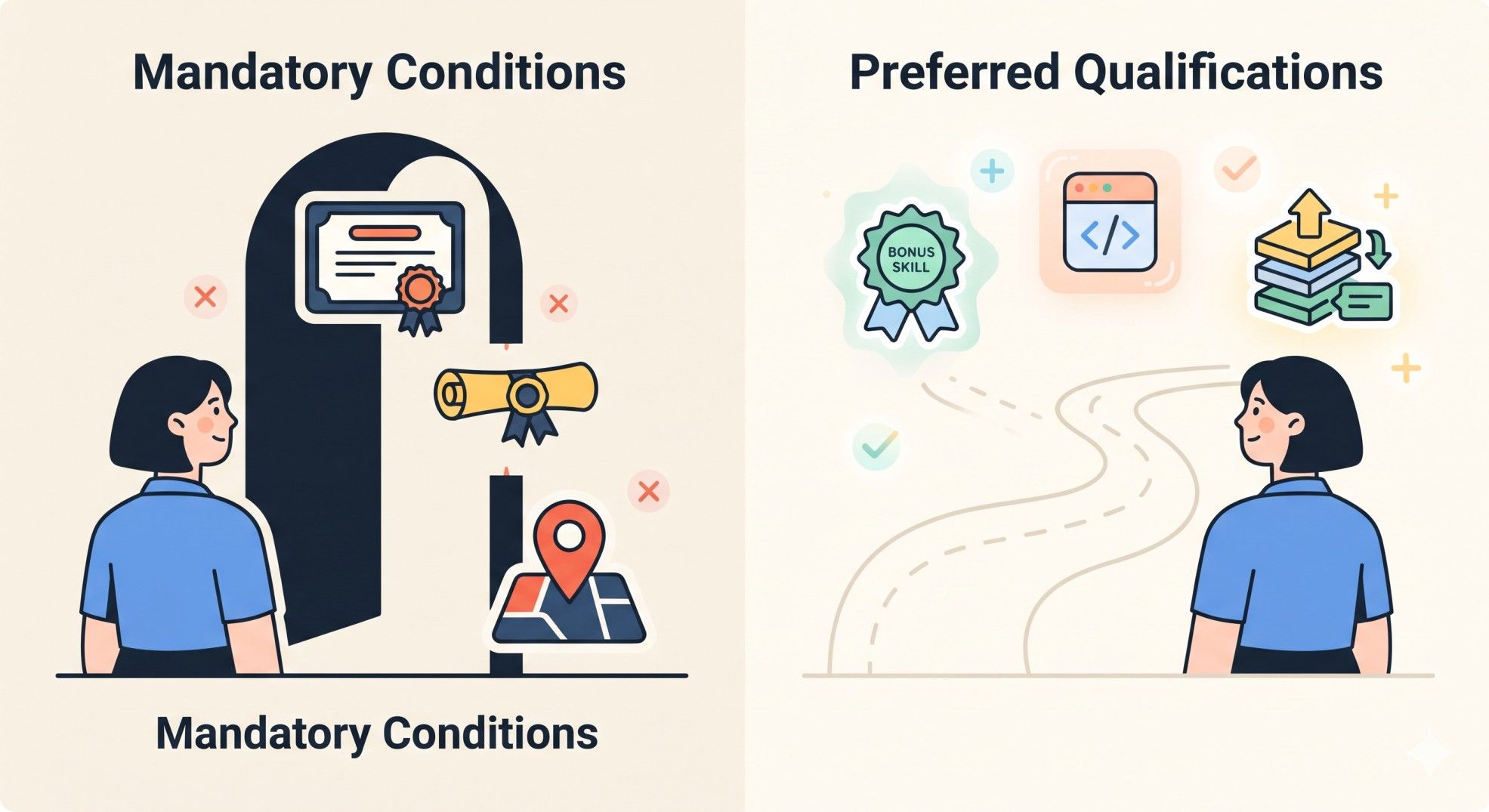
Non-negotiable requirements are conditions an employer expects a candidate to meet to be considered for a particular role.
These can be professional, educational, technical, or practical.
For example, a job may require:
- A specific professional license.
- A minimum number of years of relevant experience.
- Fluency in a particular language.
- Legal authorization to work in a country.
- Experience with a specific technology.
- A particular degree or certification.
- Availability for a required work schedule.
Some requirements are easy to spot:
"Candidates must have at least five years of experience in enterprise sales."
Others can be buried elsewhere in the posting:
"This position requires employees to work from the New York office four days per week."
Both can affect whether the role is realistically suitable.
The important part is separating these conditions from qualifications that would simply strengthen an application.
Which requirements are usually non-negotiable?
There isn't a universal rule for every job description. However, certain types of requirements are more likely to be mandatory.
Required qualifications
Educational and professional qualifications can be hard requirements, particularly when the posting explicitly states that they are required.
These might include:
- Bachelor's or master's degree.
- Professional license.
- Industry certification.
- Security clearance.
- Specific academic qualification.
A qualification listed under "required qualifications" deserves more attention than one listed under "preferred qualifications."
Minimum experience
Experience requirements can provide another strong signal.
For example:
"Minimum 5 years of experience in B2B SaaS sales."
The word "minimum" makes the expectation more specific than:
"Experience in B2B SaaS sales preferred."
A candidate with four years of highly relevant experience may still choose to apply, particularly when the rest of the profile is a strong match. But a stated minimum should not be treated as if it doesn't matter.
Required technical skills
Some roles depend heavily on particular technical capabilities.
A software engineering position might require:
- Python.
- Java.
- SQL.
- AWS.
- API development.
A design position might require:
- Figma.
- Adobe Creative Suite.
- UX research.
When a technology is central to the work and explicitly marked as required, it deserves more weight when assessing job fit.
Licenses and certifications
Some roles cannot be performed without a particular license or credential.
Examples can include professional licenses, regulated certifications, and security clearances.
These requirements are different from skills that can potentially be learned after joining the company. If the role legally requires a credential that the candidate doesn't have, it may be a genuine blocker.
Location and work authorization
Practical conditions can determine eligibility just as much as professional qualifications.
A job may require:
- The candidate to live in a particular country.
- Legal authorization to work there.
- Willingness to relocate.
- Regular attendance at a specific office.
- Availability for particular working hours.
- Willingness to travel.
Someone can be highly qualified for the work and still be unable to meet one of these conditions.
Language requirements
Language proficiency may be essential for roles involving customers, clients, international teams, or specific markets.
If a posting states that fluency in a particular language is required, it should be evaluated differently from a language listed as a bonus.
Work arrangement
Remote, hybrid, and office-based requirements can also affect whether an opportunity is realistic.
For example, someone searching exclusively for remote positions may not want to spend time tailoring an application for a role that requires three days in an office every week.
These conditions should be identified before investing significant time in the application.
How to identify non-negotiable requirements with AI
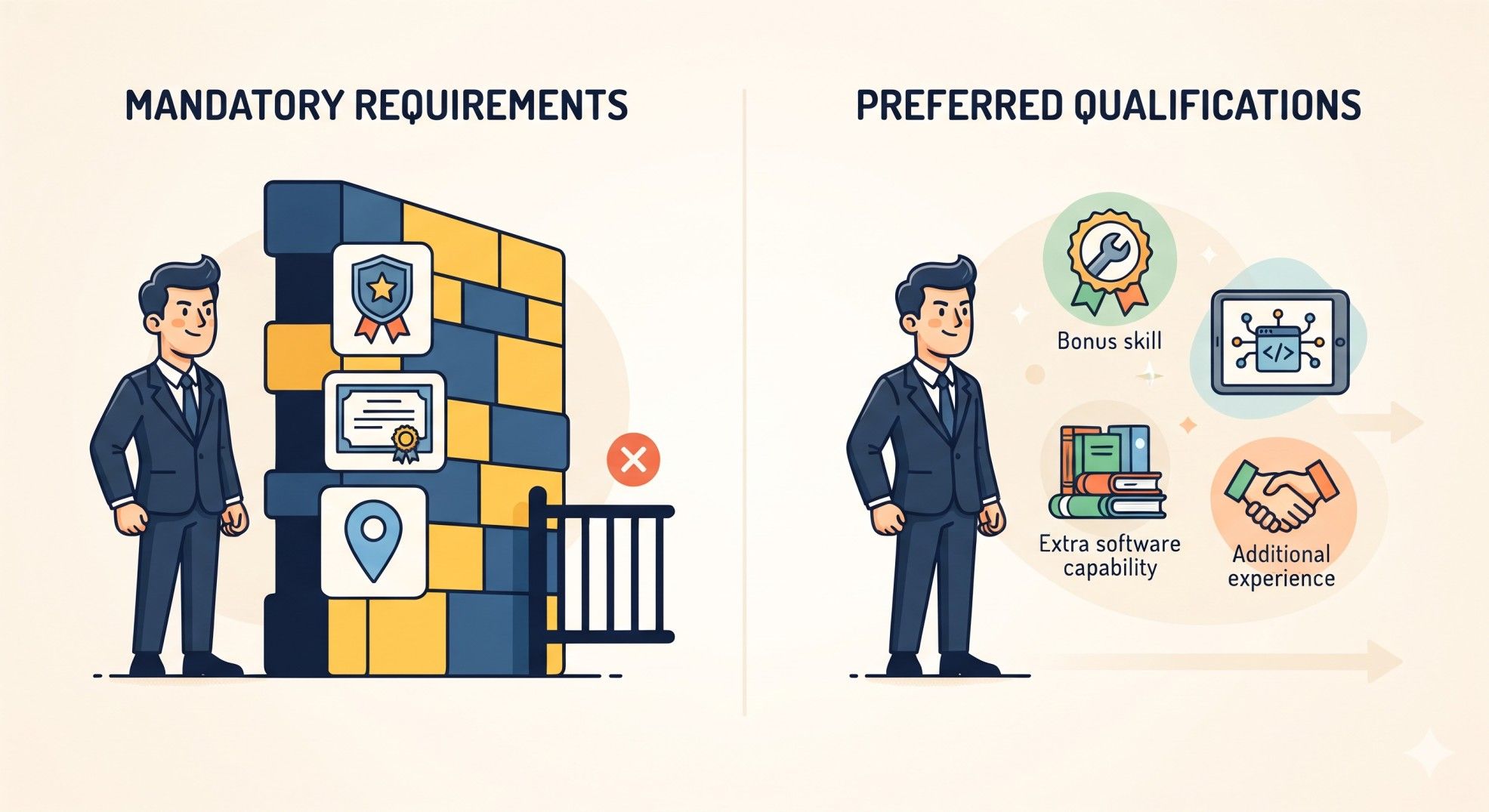
A long job description can contain everything from essential qualifications to broad statements about the ideal candidate. AI can help organize that information into something easier to assess.
Ask AI to separate required and preferred qualifications
Instead of asking AI for a general summary, give it a specific task.
For example:
"Separate the requirements in this job description into mandatory, preferred, and general responsibilities. Explain why each requirement belongs in that category."
This gives the analysis a clear purpose.
The candidate should still review the result because AI may interpret ambiguous wording differently from the employer.
Look for requirement language
Certain phrases provide useful signals.
Look for terms such as:
- Must have.
- Required.
- Minimum.
- Mandatory.
- Essential.
- Necessary.
- Legally required.
Softer phrases can indicate a preference rather than a strict condition:
- Preferred.
- Nice to have.
- Ideally.
- Bonus.
- A plus.
- Would be an advantage.
These aren't absolute rules, but they provide useful clues when sorting requirements.
Check how the requirement connects to the actual work
A requirement becomes easier to assess when it is considered alongside the responsibilities of the position.
For example, if a role involves building financial models every day and advanced Excel appears under required skills, that requirement is likely central to the position.
If presentation skills appear under preferred qualifications while the main responsibilities focus on data analysis, the missing presentation experience may carry less weight.
AI can help connect individual requirements to the responsibilities described elsewhere in the posting.
Identify requirements hidden outside the qualifications section
Not every deal-breaker appears under a "Requirements" heading.
A posting might say:
"The successful candidate will be expected to travel up to 30%."
Or:
"Applicants must be available to work US Eastern Time hours."
These details can materially affect whether the position works for a candidate.
AI can scan the full posting and flag these conditions alongside the professional requirements.
Compare the requirements with the candidate's background
Once the requirements have been separated, compare them with the resume.
For example:
This makes the decision more concrete than simply looking at an overall match percentage.
Pro Tip: LoopCV's Resume Keywords Scanner can help compare a resume with a job description and identify relevant keyword alignment. Use the results to see which important requirements are already represented and which areas need closer attention before deciding whether to apply.
How to tell a must-have from a preferred qualification
The wording of a job description provides clues, but context matters too.
Consider these two statements:
"Experience with Salesforce is required."
"Experience with HubSpot is preferred."
The first is clearly positioned as a requirement. The second suggests that HubSpot experience would strengthen an application but may not be essential.
Another useful question is whether the requirement is necessary to perform the work.
A specific professional license may be essential because the role cannot legally be performed without it. A particular software tool may be easier to learn after joining the company.
When the wording isn't clear, consider:
- Is it explicitly marked as required?
- Is it necessary to perform the core responsibilities?
- Does the employer suggest that equivalent experience can substitute for it?
- Is it a qualification that can realistically be learned after joining?
These questions provide more context than simply counting how many requirements the candidate meets.
What to do when you don't meet a non-negotiable requirement
Not every missing requirement has the same consequence.
If the missing requirement is a legal qualification, work authorization condition, or license, applying may not be practical.
If the gap concerns experience or a specific tool, the situation can be less straightforward.
For example, a candidate may have five years of experience with one CRM while the employer requests four years with another. The tools aren't identical, but the candidate's broader CRM experience may still be relevant.
Look at the substance of the requirement, not just the exact wording.
A useful way to classify gaps is:
- Hard blocker: The candidate cannot realistically meet the requirement.
- Significant gap: The candidate lacks an important capability central to the role.
- Transferable gap: Similar experience exists, but the terminology or tool is different.
- Minor gap: The requirement is preferred or relatively easy to demonstrate through adjacent experience.
This makes the application decision more deliberate.
Pro Tip: LoopCV's AI CV Checker can help review how clearly a resume communicates the candidate's existing qualifications and experience. Use the feedback to improve the presentation of genuine strengths rather than trying to disguise requirements that aren't actually met.
How AI can help without making the application decision
AI is useful for organizing information, but some parts of the decision remain personal.
AI can identify that a role requires relocation. It cannot decide whether relocation is acceptable.
It can identify a five-year experience requirement. It cannot determine exactly how much weight an employer will give to a candidate with four years of highly relevant experience.
It can compare the listed skills with a resume. It cannot determine whether the role fits the candidate's long-term career plans.
A useful workflow is:
AI identifies → candidate verifies → candidate decides.
This keeps AI focused on analysis while leaving the final judgment with the person submitting the application.
Common mistakes when analyzing job requirements
Treating every requirement as mandatory
Job descriptions often describe an ideal candidate rather than a strict checklist.
A preferred qualification shouldn't automatically become a reason to reject an otherwise strong opportunity.
Assuming every required skill is equally important
A job description may list several required skills, but they won't necessarily have identical importance in the day-to-day work.
Look at how each skill connects to the core responsibilities.
Ignoring practical requirements
Location, work authorization, schedule, travel, and work arrangement can determine whether an opportunity is viable.
Letting AI make the final decision
AI can classify requirements and identify gaps, but it doesn't know every personal or professional factor that matters to the candidate.
Adding missing requirements to the resume
If AI identifies a skill as important but the candidate doesn't actually have it, adding that keyword won't solve the underlying gap.
Resume optimization should never become skill inflation.
Focusing only on the requirements section
Important information can appear throughout the posting.
Responsibilities, working arrangements, travel expectations, application instructions, and eligibility conditions can all influence whether a job is worth pursuing.
How to use AI to decide whether a job is worth applying to
Once the job description has been analyzed, create a simple decision framework.
Strong fit
Most essential requirements are met, the responsibilities closely match previous experience, and the practical conditions work.
Action: Prioritize the application.
Possible fit
There are one or two gaps, but the candidate has closely related experience or transferable skills.
Action: Investigate the gaps and decide whether the application is still worthwhile.
Weak fit
Several core requirements are missing, or the actual work is substantially different from the candidate's background.
Action: Consider spending the application time elsewhere.
This approach becomes especially useful when AI has surfaced a large number of potential jobs. Instead of applying based on a match score alone, candidates can use AI to narrow the list and then spend human attention on the opportunities that look realistic.
Pro Tip: LoopCV's AI Job Search Tool can help narrow the job search based on relevant preferences and target roles. A more focused search makes it easier to spend application time on opportunities that have a realistic connection to the candidate's goals.
How LoopCV can help evaluate job fit
Identifying requirements is one part of deciding whether a role is worth pursuing. LoopCV offers several tools that can support different stages of the job search and application process.
- Find relevant opportunities: The AI Job Search Tool helps candidates discover jobs based on their search preferences and target roles.
- Check resume quality: The AI CV Checker helps review the resume and identify areas that may need improvement.
- Compare job requirements: The Resume Keywords Scanner helps compare resume content with the language and requirements in a job description.
- Build and tailor resumes: The AI CV Builder can help create or customize resume content for specific opportunities.
- Create cover letters: The AI Cover Letter Generator helps prepare application-specific cover letters.
- Automate applications: LoopCV can automate repetitive parts of applying to suitable jobs, reducing manual work during a job search.
- Track applications: Application tracking features help candidates organize submitted applications and monitor their progress.
These tools can make the process more efficient, but they work best when the candidate remains involved in the decision. AI can help sort the information and surface potential gaps. The candidate decides which requirements matter and whether the opportunity is genuinely worth pursuing.
Conclusion
A job description isn't a flat list of conditions. Some requirements determine eligibility, others describe the employer's ideal candidate, and some simply provide context about the role.
AI can make that distinction easier by pulling requirements out of lengthy job descriptions, grouping them by importance, and comparing them with the candidate's background. The useful part isn't getting an AI-generated "yes" or "no." It's understanding why a role may or may not be a realistic fit.
Before applying, check the requirements that could genuinely rule out the application, then look at the responsibilities, transferable experience, and practical conditions. That extra layer of evaluation can help turn a broad list of potential jobs into a more focused application pipeline.
FAQs
What are non-negotiable requirements in a job description?
They are conditions an employer expects candidates to meet, such as mandatory qualifications, minimum experience, required licenses, work authorization, or specific technical capabilities.
How can AI identify mandatory requirements in a job description?
AI can analyze the wording and context of a job description to separate mandatory requirements from preferred qualifications and general responsibilities. The candidate should still verify the interpretation.
Should I apply if I don't meet one requirement?
It depends on the requirement. Missing a license, legal qualification, or work authorization condition may be a hard blocker. A gap involving a preferred skill or comparable experience may still leave room for consideration.
What words indicate a requirement is mandatory?
Terms such as "required," "must have," "mandatory," "essential," "minimum," and "necessary" can indicate that a requirement carries greater weight.
Can AI tell me whether I should apply for a job?
AI can help assess how closely a job's requirements align with a candidate's background, but it shouldn't make the final decision. Personal preferences, career goals, transferable experience, and practical circumstances also matter.