AI Job Search vs Traditional Job Search: Pros, Cons, and How to Combine Them
AI changes how much of a job search you can do and how fast, not what ultimately gets you hired. AI speeds up searching, tailoring resumes, applying, and tracking. Fit, honesty, relationships, and interview performance still decide the outcome, just as they did before.
The shift also runs both ways. Job seekers use AI to apply, and employers use AI to screen, so a modern search has to work for both software and people. Here’s what changes at each stage, what stays the same, and how to combine both approaches.
- AI speeds up the repetitive parts of a job search: finding listings, tailoring documents, applying, and tracking progress.
- Employers increasingly use AI too, mainly to write job postings, screen resumes, and schedule interviews.
- Higher application volume across the market makes relevance and quality more important, not less.
- Networking, referrals, and interview performance still depend on human judgment and relationships.
- The most effective approach combines AI for efficiency with traditional methods for targeting and connection.
- LoopCV automates the repetitive steps so candidates can spend more time on the parts that need a personal touch.
What’s the difference between AI and traditional job search?
A traditional job search relies on manual effort at every step. Candidates browse job boards, write each application themselves, network in person or by email, and track progress in spreadsheets or memory.
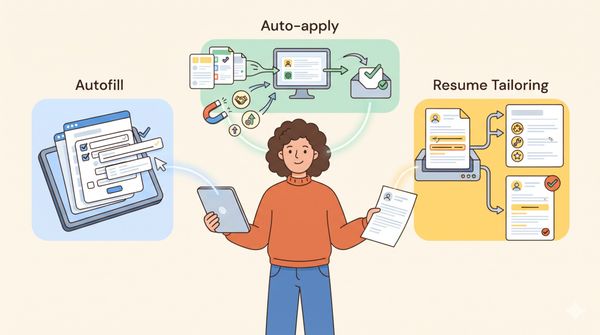
An AI job search uses software to handle parts of that process. Tools can match candidates to relevant listings, draft tailored resumes and cover letters, submit applications, and organize follow-ups.
Here’s how the two compare across the main stages:
| Stage | Traditional job search | AI job search |
|---|---|---|
| Finding jobs | Browsing job boards one by one | Matching across many sources automatically |
| Resume | One version, edited by hand | Tailored versions for each role |
| Applying | Manual forms, a few per day | Batches of applications, with optional review |
| Networking | Personal contacts and events | AI-drafted outreach and contact discovery |
| Interviews | Practice with friends or mentors | AI mock interviews and question prep |
| Tracking | Spreadsheets and notes | Automated dashboards |
The comparison between AI job search and traditional job boards focuses on the job-finding stage. The sections below cover the full process.
What changes at each stage of the job search
AI affects some stages much more than others. Here’s where the differences show up most.
1. Finding jobs
Traditional: Candidates search each job board separately, repeat the same filters, and often miss roles posted on company sites or niche boards.
With AI: Tools pull listings from multiple sources and rank them by how well they match the candidate’s profile. New matches can arrive automatically, without repeated manual searches.
What it means: Discovery takes less time, but matching quality depends on the information the tool receives. A vague profile produces vague matches.
Example: A marketing specialist targeting remote content roles might spend an hour a day checking four job boards. An AI tool can run the same search continuously and surface only roles that match the title, location, and experience level.
Pro Tip: LoopCV’s Job Posting Aggregator collects listings from multiple job boards into one dashboard, so you don't have to repeat the same search on every site.
2. Resumes and cover letters
Traditional: Most candidates use one resume for everything, or spend 30 to 60 minutes tailoring each application.
With AI: A resume and cover letter can be adapted to a specific job description in minutes, with keywords and achievements reordered for relevance.
What it means: Tailoring becomes realistic for every application, but accuracy becomes riskier. In Greenhouse’s 2026 candidate survey, 40% of US job seekers who tried to get past automated screening added skills or keywords they didn’t have. Those claims usually surface in interviews.
Example:
- Generic bullet: “Managed social media accounts.”
- AI-tailored for a B2B role: “Managed LinkedIn content strategy for a B2B software brand, growing followers by 40% in a year.”
The tailored version only works if the details are true.
3. Applying
Traditional: Candidates fill out forms one at a time, often re-entering the same information.
With AI: Tools can submit applications in batches, pre-fill forms, and answer routine questions.
What it means: Volume has risen across the whole market. LinkedIn received 11,000 applications per minute in 2025, a 45% increase from the previous year, according to figures reported by The New York Times. More volume means more competition for attention, which makes relevance more important. A focused set of strong matches usually beats hundreds of loosely related applications.
How to keep both speed and quality is covered in how to apply to jobs faster.
4. Screening on the employer side
Traditional: Recruiters read resumes, often after basic keyword filters in an applicant tracking system.
With AI: Employers use AI to screen and match resumes, write job postings, and schedule interviews. SHRM’s State of AI in HR 2026 research found that 27% of organizations use AI in talent acquisition, more than in any other HR function.
What it means: Many applications are now filtered before a person reads them. In Greenhouse’s survey, 81% of US job seekers had been rejected in the past year without speaking to anyone at the company. When both sides automate, applications can multiply without any real conversation taking place. LoopCV describes this cycle as the AI hiring doom loop.
5. Networking and outreach
Traditional: Candidates rely on personal contacts, events, alumni networks, and handwritten messages.
With AI: AI can find recruiter contacts, draft personalized messages, and schedule follow-ups.
What it means: Outreach becomes faster, but relationships still depend on genuine, specific communication. A generic AI message to a hiring manager is easy to ignore. Referrals remain one of the most reliable routes to an interview. Nearly half of the job seekers in Greenhouse’s survey had sought one to get noticed.
For this reason, LoopCV’s approach to emailing recruiters automatically focuses on relevance over volume.
6. Interviews
Traditional: Candidates prepare with friends, mentors, or by reading common questions, and every interview involves a person.
With AI: Candidates can practice with AI mock interviews and generate likely questions for a specific role. Employers are also using AI in interviews: 48% of US job seekers in Greenhouse’s survey had taken an AI interview in the past year.
What it means: Preparation is easier and more targeted. Candidates also need to be comfortable with new formats, such as one-way video interviews and AI-led screening conversations.
Pro Tip: Practicing out loud makes a bigger difference than reading answers. LoopCV’s AI Mock Interview lets candidates rehearse role-specific questions and refine their answers before the real conversation.
7. Tracking and follow-up
Traditional: Spreadsheets, email folders, and memory—hard to manage beyond a few dozen applications.
With AI: Dashboards automatically record every application, along with status, responses, and next steps.
What it means: Fewer opportunities slip through the cracks, and follow-ups happen on time.
What doesn’t change with AI
Some parts of a job search look the same as they did before AI:
- Fit matters most: Applying to roles that match the candidate’s skills and goals still produces the best results.
- Honesty matters: Inaccurate resumes and inflated claims still come up in interviews and reference checks.
- Relationships matter: Referrals and recommendations still open doors that applications alone don’t.
- Judgment matters: Deciding which roles to pursue, how to answer sensitive questions, and which offer to accept stays with the candidate.
- Interviews matter: Hiring decisions still depend on how well candidates communicate in conversation.
Knowing which parts of a job application need human review helps decide where AI should stop and personal attention should take over.
Pros and cons of each approach
Neither approach is better in every situation. Each has clear strengths and limits.
| Traditional job search | AI job search | |
|---|---|---|
| Pros | Full control over every application; stronger personal connections; easier to stay highly targeted | Much faster; tailoring is realistic for every role; wider reach; automatic tracking |
| Cons | Time-consuming; hard to tailor at scale; easy to lose track | Risk of generic or inaccurate content; can encourage applying too broadly; requires reviewing output |
When a traditional job search still works better
AI tools aren’t always the best fit. A traditional approach often works better for:
- Senior and executive roles: These often fill through networks, referrals, and executive recruiters.
- Small local employers: Many hire through word of mouth or in-person contact.
- Highly specialized fields: Niche roles may be posted on industry-specific boards or shared in professional communities.
- Career changers: A personal story often needs more explanation than a tailored resume can give.
- Dream companies: A handful of priority employers usually deserve fully manual, highly personalized applications.
How to combine AI and traditional job search
The most effective searches use AI for volume and speed, and traditional methods for targeting and connection. A weekly routine might look like this:
| Day | Activity | Approach |
|---|---|---|
| Monday | Review and adjust job search settings and target roles | AI |
| Daily (20–30 minutes) | Review new matches and approve relevant applications | AI, with human review |
| Tuesday | Send personalized messages to 3–5 contacts at priority companies | Traditional |
| Wednesday | Apply manually to 1–2 dream roles with fully tailored materials | Traditional |
| Thursday | Practice interviews for upcoming conversations | AI |
| Friday | Follow up on applications and conversations, and update tracking | AI and traditional |
This balance keeps the pipeline full without losing the personal effort that leads to interviews. How to build a job search system using AI tools explains how to set up a routine like this in more detail.
Pro Tip: LoopCV’s Job Search Checklist helps structure each stage of the search, so nothing important gets skipped when switching between automated and manual work.
How LoopCV helps combine AI and traditional job search
LoopCV handles the repetitive parts of a job search, giving candidates more time for networking, preparation, and applications that deserve extra attention.
- Find relevant roles: The AI Job Search Tool and Job Matching surface openings that fit the candidate’s profile.
- Search multiple job boards: The Job Posting Aggregator brings listings from multiple sources into one place.
- Prepare strong documents: The AI CV Checker, AI CV Builder, and Cover Letter Generator help create tailored, accurate applications.
- Check keyword alignment: The Resume Keywords Scanner compares a resume with a specific job description.
- Apply with control: Auto Apply handles repetitive submissions, while One-Click Apply lets candidates review each match first.
- Reach recruiters directly: The Email Finder and Dynamic Emails support personalized outreach.
- Prepare for interviews: The AI Mock Interview helps candidates practice role-specific questions.
- Track everything: The Job Application Tracker keeps applications, responses, and follow-ups organized.
AI handles the speed and scale. The choices about where to apply, what to say, and which opportunities to pursue remain with the candidate.
Conclusion
AI has changed how a job search runs. Finding listings, tailoring resumes, applying, and tracking progress are all faster than before, and employers use AI on their side of the process too. That makes relevance, accuracy, and personal connection more valuable, not less.
The strongest approach combines both. Use AI to handle the repetitive work and keep the pipeline full. Use traditional methods for networking, priority applications, and interview preparation. That balance gives candidates both reach and the personal effort that still decides who gets hired.
FAQs
Is AI job search better than traditional job search?
Neither is better in every case. AI is faster and makes tailoring realistic at scale, while traditional methods are stronger for networking, senior roles, and highly targeted applications. Most candidates get the best results by combining them.
Do employers use AI to screen applications?
Many do. SHRM’s 2026 research found that 27% of organizations use AI in talent acquisition, commonly to screen resumes, write job postings, and schedule interviews.
Can AI apply to jobs for me?
Yes. Tools such as LoopCV can submit applications automatically or let candidates review each match first. Reviewing important applications and answers to sensitive questions is still recommended.
Does using AI hurt my job applications?
Not when it’s used carefully. Problems come from generic content, inaccurate claims, and applying to roles that don’t fit. Accurate, tailored AI-assisted applications can perform as well as manual ones.
Is networking still important in an AI job search?
Yes. Referrals and personal connections remain one of the most reliable ways to get an interview, especially as application volumes rise and more screening is automated.