
LinkedIn Premium: Is It Worth Paying For in 2026?
LinkedIn Premium Career is designed for people who are actively looking for work, changing careers, or trying to move into a better role. It adds features that aren't available in the same way on a free LinkedIn account, including InMail, applicant insights, profile-view information, LinkedIn Learning, and AI-powered job-search tools.
But does paying for those features actually make a difference?
The answer is mixed. Some job seekers say Premium helped them connect with recruiters, find better opportunities, or get more useful information during their search. Others say they paid for it and saw little difference.
So, is LinkedIn Premium worth paying for? Here's what it offers, what people like about it, where it falls short, and what you're actually paying for.
- LinkedIn Premium Career adds InMail, profile-view insights, applicant insights, Top Applicant and Top Choice features, AI-powered job-search tools, LinkedIn Learning, and AI coaching to the features available on free LinkedIn. The article examines whether these additional features justify the cost and where Premium provides the most value.
- Premium is most useful for focused job searches where candidates actively use recruiter outreach, InMail, applicant insights, profile data, company research, or LinkedIn Learning. It can be particularly useful for networking-heavy searches, senior candidates, career changers, and people targeting harder-to-reach opportunities.
- Free LinkedIn already covers the basics: creating a profile, searching and applying for jobs, networking, and receiving job alerts. Premium mainly adds deeper insights, access, and career-development tools.
- Premium does not guarantee better results. User experiences are mixed, and LinkedIn's reported response-rate improvements should be treated as platform averages rather than individual guarantees.
- The verdict: Premium can be worth paying for during a focused, networking-heavy job search, while candidates who mainly search and apply may find free LinkedIn sufficient. LoopCV can handle repetitive application work such as job discovery, applications, autofill, screening questions, and tracking.
What do you get with LinkedIn Premium?
LinkedIn Premium Career includes several features built around job searching and career development:
- 5 InMail messages every month to contact people outside your network
- Who viewed your profile, including viewer trends and insights
- Applicant insights for eligible job postings
- Top Applicant features for jobs where your profile appears to be a strong match
- Top Choice Jobs to signal interest in selected roles
- Advanced job-search insights
- AI-powered job insights
- AI-assisted profile and message writing
- LinkedIn Learning, with access to 25,000+ courses
- AI-powered coaching within LinkedIn Learning
LinkedIn also says Premium members are 39% more likely to hear back after applying for a job on LinkedIn. It says Premium subscribers who use Top Choice Jobs are 43% more likely to receive a recruiter response. These figures come from LinkedIn's own platform data, so they should be treated as LinkedIn's reported averages rather than a guarantee for an individual subscriber.
What don't you get with free LinkedIn, and how much does Premium cost?
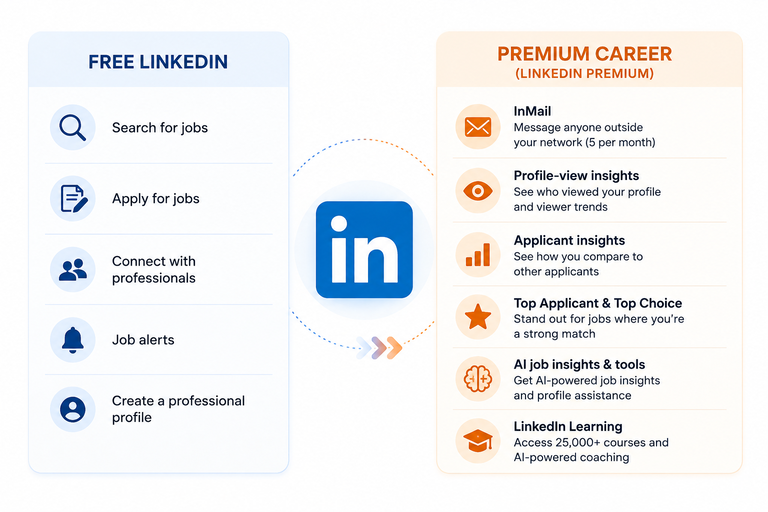
A free LinkedIn account already lets users create a professional profile, connect with people, search for jobs, receive job alerts, and apply for positions.
Premium adds more information, access, and career tools around those activities.
LinkedIn's current Premium Career pricing starts at US$39.99 per month or US$239.88 per year. LinkedIn says the annual option represents a 50% saving compared with monthly billing. Pricing varies by country, taxes, billing option, and promotions.
Eligible users may also receive a free trial, depending on their account and current offer.
The good side of LinkedIn Premium
The strongest case for Premium is that it gives job seekers more access and more information while they are searching.
1. InMail can make targeted networking easier
Premium gives users five InMail messages each month, allowing them to contact people outside their existing network.
That can be useful when a job seeker has identified a specific recruiter or hiring manager they want to reach.
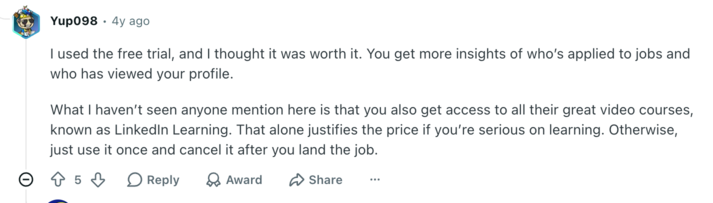
The Reddit discussion that sparked much of the conversation around Premium has users on both sides. One user says Premium was worth it because they were recruited through their LinkedIn profile and canceled it immediately after getting hired. Another says the value may depend on being able to directly communicate with hiring managers and decision-makers, particularly in competitive searches.
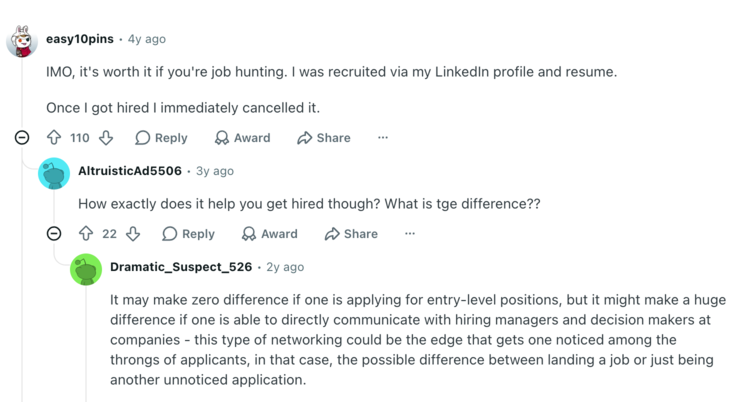
That is probably the strongest argument for InMail: it gives someone another route to start a conversation with a person they otherwise couldn't message directly.
Note: If you're planning to use LinkedIn Premium mainly for recruiter outreach, it also helps to know what to actually say once you get that access. How to Reach Out to a Recruiter on LinkedIn
2. Applicant insights can help you decide where to apply
Premium also gives users additional information about the applicant pool and identifies jobs where they may be a strong match.
Some users see this as one of the more useful Premium features because it helps them decide which jobs deserve their time.
In the same Reddit discussion, one user specifically says the applicant information and Top Applicant feature help them judge whether a job is worth applying for.
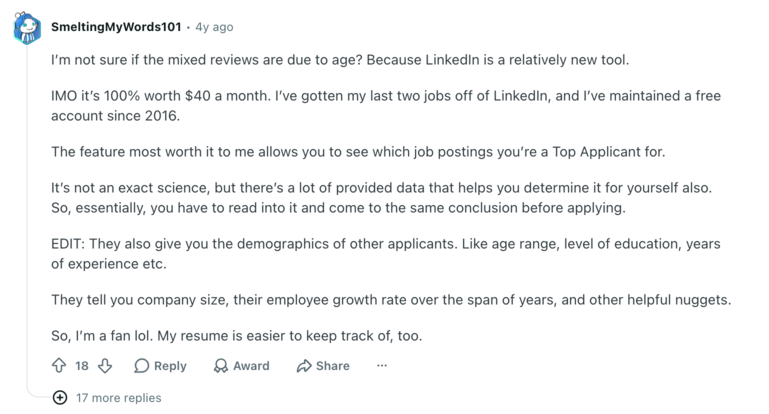
The information can therefore be useful for prioritizing applications, even though it doesn't guarantee an interview.
3. Seeing profile viewers can give you potential networking leads
Premium provides more information about who has viewed your profile.
For someone actively networking, this can be useful when a relevant recruiter or person from a target company appears among those viewers.
Users in the Reddit discussion describe using profile-view information to identify recruiters and companies that may already have some interest in their background.
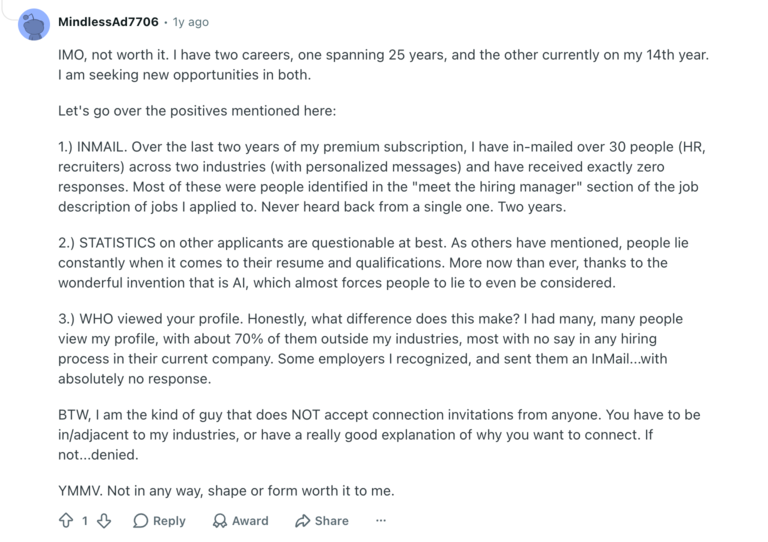
The feature becomes much more useful when the information leads to an actual networking conversation.
4. LinkedIn Learning adds another reason to subscribe
Premium Career includes access to more than 25,000 LinkedIn Learning courses.
For someone who is already planning to learn a new skill, prepare for a career change, or improve their professional knowledge, that can add significant value to the subscription.
Some Reddit users also mention LinkedIn Learning as one of the Premium features they found useful.
Where LinkedIn Premium falls short
The criticism is just as important because many users don't feel that the extra features change their actual job-search results.
1. Paying for Premium doesn't guarantee recruiter attention
This is probably the biggest criticism.
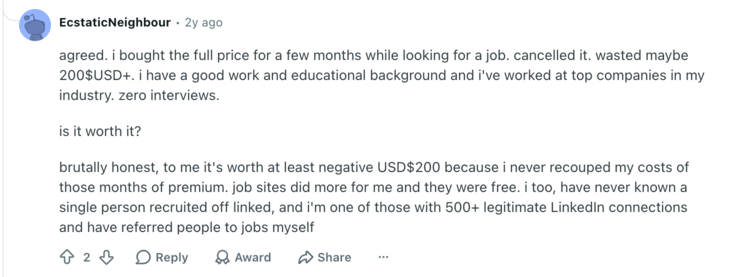
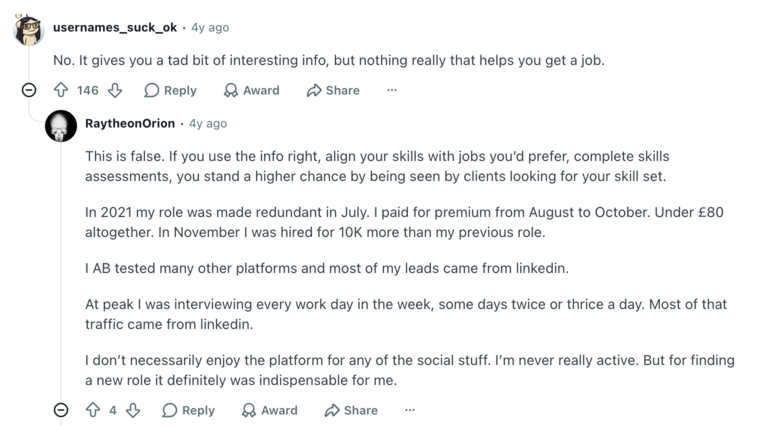
This Reddit discussion includes users who paid for Premium while actively searching and still received little response from recruiters. Others say their successful opportunities came through ordinary applications, networking, or recruiters reaching out on their own.
A separate discussion shows the same divide. Some users say Premium brought more recruiters into their inbox, while others say they were still not getting jobs despite having Premium.
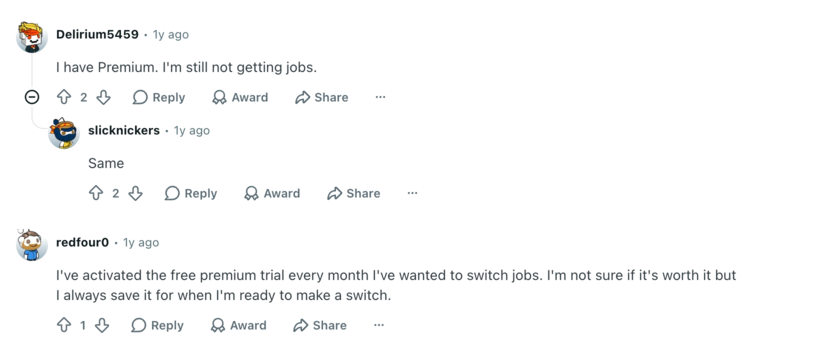
So the additional access doesn't necessarily translate into additional opportunities.
2. InMail can still result in silence
The ability to message a recruiter doesn't mean the recruiter will respond.
That's one of the clearest criticisms across user discussions. Some people say direct outreach helped them get conversations, while others describe sending messages without receiving useful responses.
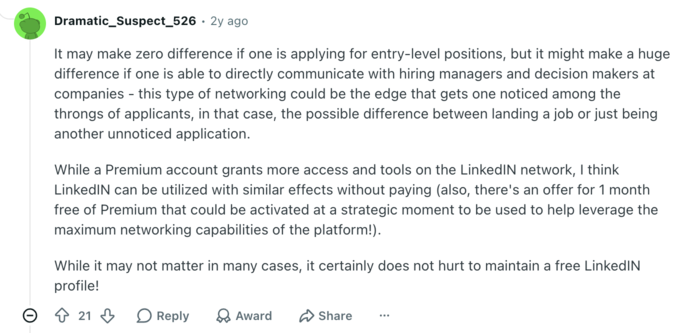
This makes the quality and targeting of the outreach more important than simply having InMail available.
3. Premium doesn't fix a weak profile
Premium can provide more information and more ways to contact people. It doesn't make a weak profile, resume, or application stronger.
This point also appears in Reddit discussions, where users argue that profile quality, relevant skills, experience, and networking matter more than simply paying for Premium.
Pro Tip: Before increasing application volume, check your resume for ATS compatibility and missing keywords with LoopCV's free ATS Resume Checker.
4. The job recommendations don't always feel accurate
One user said, after testing it for a month, that many of the recommended roles didn't feel like genuine matches and appeared to rely heavily on keyword overlap. She also said that marking jobs as poor matches didn't always stop similar recommendations from appearing.
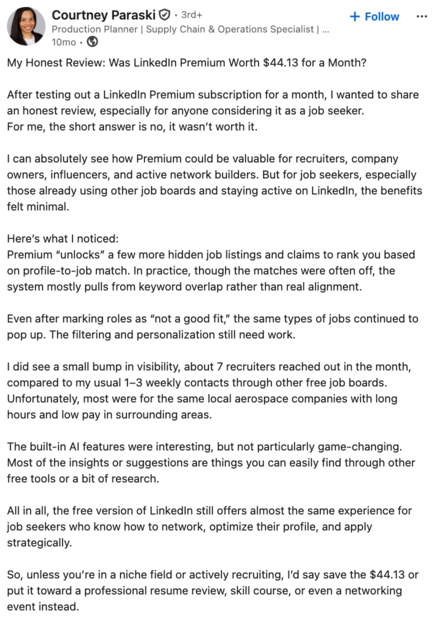
Interestingly, she did see more recruiter activity during her Premium month, but she didn't consider most of that outreach valuable enough to justify the subscription.
5. Some users don't think the price matches the value
This is where the criticism becomes particularly direct.
A Reddit discussion has users questioning whether Premium provides enough value to justify its price, particularly for people who are already unemployed or actively looking for work.
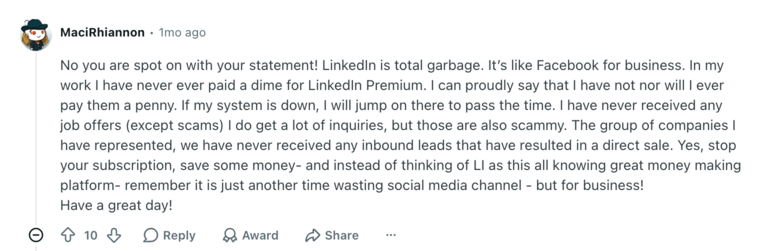
Other users say Premium can be useful during a focused job search but don't see a reason to keep paying for it indefinitely.
Here's what you're really paying for with LinkedIn Premium
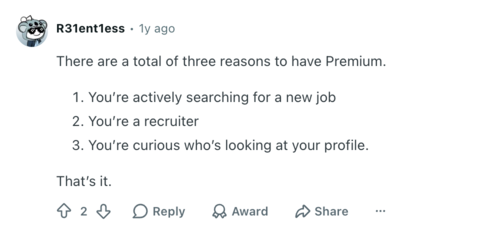
When the feature list is stripped down, Premium Career is essentially charging for four things:
- More information: applicant data, job insights, and additional profile-view information.
- More access: InMail and additional ways to reach people outside your network.
- More career tools: AI assistance, LinkedIn Learning, and career insights.
- More convenience: several job-search tools gathered inside one platform.
What you're not paying for is a guaranteed advantage in the hiring process.
Premium doesn't guarantee:
- an interview
- a recruiter response
- a job offer
- a higher ranking in an employer's ATS
- or that a recruiter will respond to an InMail
That distinction matters because the free version already covers the basic job-search process.
Premium becomes more valuable when someone actually uses its additional features.
Who LinkedIn Premium is actually worth it for
The value of Premium isn't the same for everyone. It depends heavily on where someone is in their career and what kind of job search they're actually running.
The pattern across most of these personas is the same: Premium adds the most value when someone is doing something specific with it, direct outreach, gap-bridging, or targeting a harder-to-reach market, rather than using it as a passive upgrade to a standard job search.
How LoopCV can automate the repetitive parts of your job search
A large part of job hunting has nothing to do with networking. It is the repetitive work of finding relevant jobs, opening listings, filling out forms, uploading resumes, answering screening questions, and keeping track of applications.
This is where LoopCV can automate much of the process.
With LoopCV, job seekers can:
- Find jobs across 30+ job boards, including LinkedIn, Indeed, and Glassdoor.
- Set job preferences based on roles, locations, and other criteria.
- Automate applications to supported jobs and application systems.
- Fill out repetitive application forms across platforms such as Workday, Greenhouse, Lever, and Ashby.
- Handle screening questions using saved answers and AI-powered responses.
- Track applications from one dashboard.
- Review jobs before applying with a manual mode for people who want more control.
Instead of spending hours searching and filling out the same information repeatedly, LoopCV can handle much of the repetitive work and leave more time for the parts of the job search that need personal attention.
Pro Tip: Once applications start going out, use LoopCV's AI Mock Interview to practice for the interviews those applications could lead to.
So, is LinkedIn Premium worth paying for?
After looking at the features and real user experiences, our take is simple: LinkedIn Premium can be worth it, but it isn't essential for every job seeker.
Its biggest value comes from extra access and information, such as InMail, applicant insights, profile-view data, and LinkedIn Learning. These can be useful for someone actively networking, researching companies, and targeting specific opportunities.
The deciding factor is how someone uses LinkedIn. If Premium features are going to be used regularly during a focused job search, the subscription can justify its cost. If someone mainly searches for jobs and submits applications, paying for Premium may not add enough value over the free version.
Our verdict: Premium is worth considering for a focused, networking-heavy job search. Otherwise, the free version is likely sufficient.
FAQs
1. Is LinkedIn Premium worth it for job seekers?
It can be, especially for job seekers who actively use LinkedIn for networking, recruiter outreach, applicant insights, and career development. For people who mainly search and apply for jobs, the free version may be enough.
2. Does LinkedIn Premium help you get a job?
Premium can provide additional tools that may support a job search, but it doesn't guarantee interviews or job offers. LinkedIn says Premium members are more likely to hear back from recruiters, but individual results can vary.
3. What is the difference between LinkedIn Premium and free LinkedIn?
Free LinkedIn covers the basics of creating a profile, connecting with people, searching for jobs, and applying. Premium adds features such as InMail, expanded profile-view information, applicant insights, LinkedIn Learning, and additional AI-powered career tools.
4. Can you message recruiters with LinkedIn Premium?
Yes. Premium Career includes five InMail credits per month, which allow users to contact people outside their existing LinkedIn network. However, having InMail doesn't guarantee a response.
5. How much does LinkedIn Premium Career cost?
LinkedIn Premium Career starts at $39.99 per month in the US, with annual billing available at a lower effective monthly cost. Pricing can vary by country, billing option, taxes, and promotions.
6. Can LinkedIn Premium replace other job-search tools?
Not necessarily. Premium adds features within LinkedIn, while other job-search tools can help with tasks such as finding jobs across multiple platforms, automating applications, and tracking applications. The right combination depends on how someone approaches their job search.